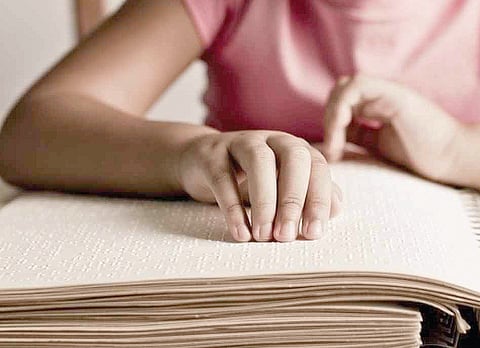

NEW DELHI: Despite tall claims by the Ministry of Human Resource Development and the authorities, Delhi University’s Braille Library that keeps books for the visually impaired in Braille is in a shambles. Books in the library—especially for subjects like English, Economics and Science—are mostly in Hindi, making it difficult for differently abled students to read.
However, refuting claims by students, university officials say that they do not maintain Braille books as there are few visually impaired students of Economics, Mathematics and Science.
The university has made arrangements in three parts for visually challenged students: audio books, e-text and Braille print.
Luv Kush, a student of History (Honours) from Hindu College, lamented that the quality of the audio is not good. “It seems that the proof reading of the audio books is not done properly. Readers just keep on reading in one breath and the frequent mistakes and blunders mar the reading and ruin the reading material,” he says.
When The Sunday Standard visited the library to do a reality check, the new books shelf was empty.
“We do not get any new books and magazines in Braille print. Only audio books are available but there are of very bad quality,” regretted Riti Singh, a visually impaired student of Hindu College.
Sandeep Yadav, a Political Science student from the same college says, “Mistakes in Braille print and wrong pronunciations in the audio are very noticeable. Except for commas and full stops, the readers do not pause anywhere at all.”
Countering Yadav’s complaints, officials from the library said on the condition of anonymity, “We have three studios for audio recordings and each of the reader is selected by our editor for the quality of the pronunciation. After the recording is completed, it is edited and then made available to the students.”
“We mostly have Sanskrit and Hindi students, no Economics or Science student as it is difficult for them to continue studies after standard six or seven,” the official said.
A Braille printing machine that prints the “six dots” costs approximately Rs 8 lakh. “There is only one printing press with us that is functioning right now. It seems to be adequate but sometimes it gets overburdened with other work,” said another staffer of the library.
Bipin Tiwari, Official on Special Duty of the Equal Opportunities Cell in Delhi, explained why the library has more Hindi language books for Economics and other subjects. “The focus on the Hindi language is because it is our mother tongue and the students here are 75 per cent of Social Sciences who are more comfortable in Hindi,” he said.
The Equal Opportunity Cell, which looks after issues of the differently-abled in the university, has also organised a special Lex scanning machine for the visual and hearing impaired so that a student can scan the book and keep it available online or in an external drive. But the Lex scanning machine gives out all the verbal/written instructions to the visually impaired students in English, which is contradictory to the books that they are reading.
200 Number of Library Members
Rs 40,000-50,000 Cost of Lex Machine
1,618 Audio Books
229 Braille books 199 Hindi and 30 English