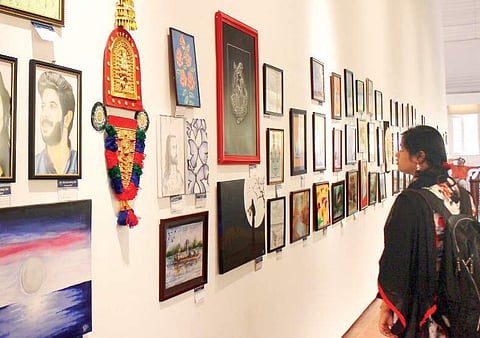

Delhi is home to about half a dozen good galleries with bankable programming. While art aficionados might rue the fact that this is an abysmal count for a city of this scale, what compounds this apparent dearth is the fact that these establishments are sprinkled liberally across the spread of the geographically vast city. Distances between galleries are huge thus there is no single area which can be termed as an art district.
Compared to the tight concentration of galleries in Mumbai’s art district, Delhi has a long distance to cover (literally!) against its culturally evolved distant cousin. The emergence of a single art district is required. Lado Sarai in south Delhi currently has the highest density of galleries, though the bulk of qualitative tenor on view here is middle-order at best.
If the lack of galleries is alarming to some, the malnourishe

d representation of museums within the modern and contemporary landscape in the city is a glaring red flag. The fort here is admirably held by the privately owned Kiran Nadar Museum of Arts (KNMA) housed in a mall in south Delhi—primarily for ease of access for art lovers.
The state-run NGMA has witnessed an ascent in its programming with a number of mid-career retrospectives unveiled, usually in conjunction with the opening of the India Art Fair.
In the capital, and the country as well, the authorities need to soften their stance on all deserving fronts, while remaining strict as and when required. In terms of import duties, a significant reduction to a complete waiver should be in effect for all Indian artworks of the requisite pedigree that are returning to India.
In the same sweep, collectors purchasing works overseas in many instances tend to hold the assets in international ports rather than import them on account of the duty that stands at nearly 15% of cost, insurance and freight of the work. A number of culturally important assets remain outside the country of their origin where they rightfully should be on display.
The past decade has seen the market rise and fall, only to slowly find its footing on solid ground. The decade to follow will witness maturity by way of improvements in all the stated gaps as they currently stand.