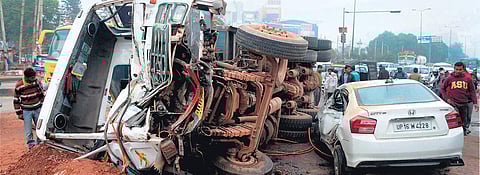

NEW DELHI: Imagine a scenario when a car smashes into a streetlight pole. Instead of coming crashing down on the car, the pole bends and slows down the car, thereby saving the passengers. A speeding SUV hits a divider on the highway and doesn’t end up as a mangled heap of metal. The divider changes the direction of the vehicle, minimising the damages.
These are not scenes from any upcoming SFX loaded movie. These are part of new technology and materials in road design being considered for approval by a high-level expert committee under the Ministry of Road Transport and Highways.
The proposals are aimed at cutting down road accident deaths in India. According to latest data, 17 people are killed in road accidents every hour in the country. India, as a signatory to the Brasilia Declaration, is committed to reducing the number of road accidents and fatalities by 50 per cent by 2020.
The panel comprises of experts such as S R Tambe, former PWD secretary Maharashtra, Prof. Ravi Sinha of IIT Mumbai and members from the ministry. The final approval on the implementation of these technologies will come from the Nitin Gadkari-led ministry.
“The idea is to certify these technologies and materials based on our road standards and weather conditions so that these can be used for ensuring safety on roads. The approval of such technologies by expert panel will allow the manufacturing companies to bid for road safety related tenders by the government,” said Prof Sinha.
The new technologies proposed include Safety Roller Barrier, which minimises the damage during accidents and ensures the safety of passengers.
The main function of the roller system is to change the direction of the vehicle which hits the barrier. The roller barrier is made high-density polymeric shock-absorbing material. It has excellent flexibility, high strength and great shock absorbing capacity. It is durable on compression and luminous in the dark.
“The company (that has submitted its proposal) claims to have cleared crash barrier tests in the US and Europe. It will have to undergo crash lab tests or demonstrate the performance of barriers by installing on pilot project during the accreditation process,” said a ministry official.
Also on the table for approval are a prefabricated drainage system which saves space on roads with effective silt management and energy absorbing steel pole for streetlighting, designed with the advantage of being passive safe in a car crash to save lives.
Submitted by a Belgian firm, the ZIP pole will bend in case of a car crash, slow down the car and absorb the energy of the shock. On impact, its conical shape changes into a soft ribbon. While the pole yields, the vehicle’s speed gets slowed down accordingly.
