
September 28: Santoshi Kumari, an 11-year-old girl in Jharkhand’s Simdega district, allegedly died of starvation as her family’s ration card was cancelled for not being linked to their Aadhaar number.
October 21: Baidyanath Ravidas, a 43-year-old rickshaw puller in Dhanbad, allegedly died of starvation as the family could not get subsidised food because didn’t have a ration card.
October 23: Rooplal Marandi, 75, died of hunger in Deoghar district after the biometric reader at the Public Distribution System (PDS) shop allegedly couldn’t read his daughter’s thumb impression and he was refused ration.
New Delhi: Although a probe is under way on the reasons behind the three deaths in quick succession, they have brought the spotlight back on the Aadhaar system, especially its mandatory linkage with social welfare schemes. Is the fledgling Aadhaar system actually ready for implementation in crucial welfare schemes? Even a brief perusal of technologies in use suggests not.
Jharkhand, beginning August 2016, began moving towards a paperless PDS, and other states followed suit after the Centre’s direction in February this year making Aadhaar mandatory for PDS. Like any internet-based technology, biometrics-based Aadhaar verification needs its communications infrastructure to fire on all cylinders at all times.
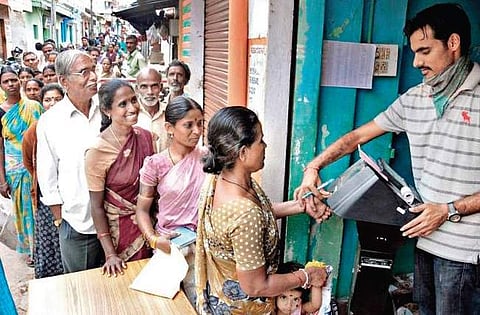
The large majority of such verification is fingerprint-based, run on Point of Sale (PoS) terminals connected by normal internet connections to remote servers where biometric data is stored and authentication is done. As the flowchart displayed enumerates, there are multiple possible points of failure—with lack of internet connectivity, and power, the most common disruptions.
While there is no available data on internet connection failures, anecdotal accounts paint a sorry picture. Power cuts and bad internet connections routinely play spoilsport. “The device we PDS dealers use while distribution ration often does not work due to power failure and internet connectivity. Sometimes, fingerprints of beneficiaries also do not match.
These are recurring problems that often obstruct the distribution to beneficiaries,” said Dharmadev Chaudhary, PDS dealer, Bhagwanpur village, Jharkhand. “We are rapidly improving our infrastructure, but a lot of mobile coverage in rural areas is still in the 2.5G band. Slower speeds are common,” pointed out Neil Shah, co-founder, Counterpoint Research.
But, while a large section of PoS terminals are also connected through faster connections, the Telecom Regulatory Authority of India (TRAI), observed in a paper dated June this year that “data speeds quoted by mobile network operators appear to be at variance with those experienced by users. For instance, crowd-sourced data from TRAI’s mySpeed portal shows that many 3G subscribers receive a download speed of less than 1 Mbps. Moreover, these ‘below 1 Mbps’ speeds can be 10 Kbps for some 3G subscribers.”
Are fingerprints reliable?
Lack of adequate internet infrastructure might be an obvious concern. But, it is not the only one. The reliability of biometric authentication based on fingerprints, over the medium and long term, has been questioned in several studies. While real-time data on biometric verification in PDS systems are not available, its use in other schemes like MGNREGA and pensions schemes are tracked.
As per Telangana’s Benefit Disbursement portal for MGNREGA and Social Security pensions, from June 2017, to the current date, the success rate for Aadhaar biometric verification was just 65.28 per cent. Out of the total of 1.37 crore transactions tracked, 47.54 lakh failed. The failure rate for fingerprint verification attempts was 65.28 per cent. For iris verifications, considered a more accurate back-up, it was just 60.69 per cent.
“While some of these are likely to be fake, there is bound to be several errors even for people eligible and on Aadhaar database. Fingerprints change during the course of time and need regular updates,” observed a senior Tamil Nadu consumer affairs department official. Multiple studies suggest that fingerprints do change, or become less reliable as verification tools, over time—especially for senior citizens, those engaged in manual labour and even those with medical conditions like leprosy or even common hand dermatitis and eczema (skin conditions). A study by the Department of Dermatology, Hospital Kuala Lumpur in 2011, concluded that for patients with hand dermatitis, fingerprint verification failed 27 per cent of the time.
Even for those not afflicted, fingerprints change. The International Biometrics Group noted that “over time, many biometric systems are prone to incorrectly rejecting a substantial percentage of users. Verifying a user immediately after enrolment is not highly challenging to biometric systems. However, after six weeks, testing shows that some systems’ error rates increase ten-fold…” Botched recordings of biometric data are also a common reason for mismatch errors.
The architect of the Unique Identification Authority of India (UIDAI) Nandan Nilekani admitted as much in one of his interviews. However, Nilekani had pointed out “iris verification is a back up”, followed by OTP-based verification. He also stated that systems needed to be designed with these back-ups in place. However, iris verification systems are non-existent in many fair price shops.
One argument is that failure rates are inflated because the same person tries to verify biometrics multiple times. However, if accounts of families that have lost loved ones are to be believed, multiple failure errors are enough to delay receiving food for days.
One rollback too late?
Experts and consumer activists have pointed out these shortcomings, even as Aadhaar verification was being implemented at breakneck pace. But the series of deaths seems to have shaken the establishment.
On October 26, the Centre clarified its February direction which had made it compulsory to have Aadhaar to avail PDS benefits and given beneficiaries until June 30 to get one. The direction however had stopped short of asking states to deny rations to those who had not complied.
Its most recent order has reiterated that previously unstated point -- states are to not to deny PDS benefits to anyone who does not have Aadhaar or has not linked his ration card to the number. The Centre has also warned of “strict action on violation” of the directive. While the order comes as a relief, it is clear that fully Aadhaar-based verification in PDS has a long way to go.
