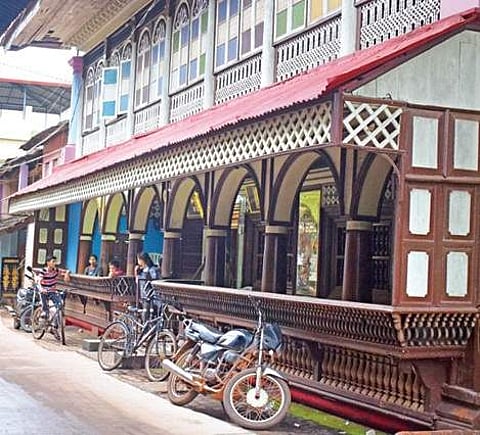

BHATKAL (KARNATAKA): Bhatkal town, located on the shores of Arabian Sea, has passed through the rule of several dynasties. And this is evident from the architectural diversity in the town. In the interiors of the town, which has been in news for the alleged involvement of some of its residents in terrorism, heritage buildings influenced by Islamic architecture are a sight for architectural enthusiasts.Most of these houses belong to Nawayaths of the Muslim community who are concentrated in Uttara Kannada and Udupi districts. The Nawayaths claim to have come to India from Arabia in the 8th century as traders, thus bringing with them influences of the architecture pre-dominant in their native regions.

The 103-year-old Barani House is a perfect example that embodies Islamic architecture. It was constructed in 1914 by Mohtishan Mohammad Meera, a textile businessman. Even after a century, the house, which was made using teakwood, stands stronger than concrete house. Mohtishan Mohammad Jafar, the grandson of Meera, says: “Many people from the state and abroad come to see our house. We are proud to live in such a beautiful house. While constructing the house, my grandfather may not have imagined that it would become such a big attraction, but today it is of heritage value.”
The 73-year-old Jafar recalls, “When I was very young, my grandpa used to tell me how he constructed the house and how he did the interior decoration. The design of the house has influences of architecture styles pervalent in Middle Eastern countries, but it was constructed by experts from Kerala. The teakwood used for the construction too was brought from Kerala.”Decorative items for the house were imported from the Middle East and stained window glasses were specially ordered from Mumbai.
The construction was completed in 1914, says Jafar. “I don’t know how much he spent to construct the house. At present, we spend nearly a lakh to paint all the walls and wooden itmes in the house,” says Jafar, who runs a textile business in Mumbai.The Barani House is palatial with six big halls, four small halls, eight bedrooms, two big kitchens with a large balcony and two dining halls. The house also has a big storehouse which is the size of four bedrooms in the house put together.