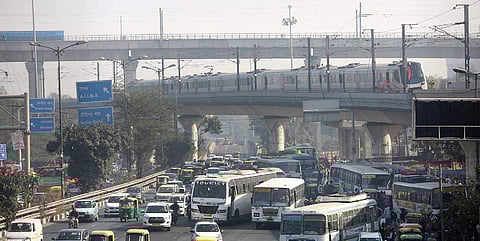

NEW DELHI: Flyovers are meant to reduce traffic congestion, but that is not so in the national capital. Transport officials say the city flyovers’ poor designs have only led to more traffic snarls.Professor Seva Ram of the Transport Planning Department of the School of Planning and Architecture says to understand design faults of flyovers, it is important to understand what aspects are taken into consideration while building them. “Design in transport planning is not only the design of the structure. The assessment done during the design stage includes relocation or demolition of structures in at least a one km radius of the flyover,” said Ram.
He added that some areas that have flyovers should not have them. “The biggest issue is of spacing. In most areas, the arrival rate of vehicles is more than the discharge rate. Guidelines suggest there must not be a traffic junction until 1.5 km of a flyover,” he said.He cites the AIIMS flyover as an example. When one heads towards Sarojini Nagar from AIIMS, the two flyovers that are not interlinked have blind spots. This makes it deadly during peak hours. Also, he says, that due to less spacing in between the flyovers and the non-proportional arrival and discharge rate of vehicles, congestion is caused.

“Usually, authorities make the mistake of taking into account only one isolated traffic junction while constructing a flyover. They must look into the entire area. The Traffic Impact Assessment of a flyover is very important,” he said.The Mahipalpur flyover was built for traffic from Gurgaon to Delhi without keeping in mind the traffic below. The six-lane road under it has deadly crossing sections with not enough room for U-turns. This leads to snarls below and at the weaving stretch, the length of the road after the flyover which facilitates merging of traffic.
Traffic police admit handling traffic in the city is a nightmare. “Flyovers have not helped reduce congestion. The mindset of a driver needs to change. If vehicles stick to their lanes and follow traffic rules, our job will be much easier,” a police official said.Ram added, “Upgradation of secondary infrastructure is extremely important. If there is a blockade in the small arteries, only a bypass of big arteries will not solve the problem.”PWD officials said they try to make flyovers as useful as possible.
Dhaula Kuan
Driving from Sardar Patel Marg towards Dhaula Kuan, vehicles going to Delhi Cantt can’t turn right just after the traffic signal and are forced to take a precarious U-turn, leading to jams. The bus stop after the flyover also forces buses to take a steep left, blocking vehicles behind and leading to congestion.
AIIMS
When one heads towards Sarojni Nagar, the two flyovers which are not interlinked have blind spots. This makes it deadly during peak hours. Spacing between the two flyovers is much less than the prescribed value. This causes traffic congestion.
Mahipalpur
The flyover was made for traffic from Gurgaon to Delhi without keeping in mind the traffic below. The six-lane road below has a deadly crossing section with not enough room for a U-turn. Many vehicles cause congestion in the narrow roads while merging with the traffic from the flyover.