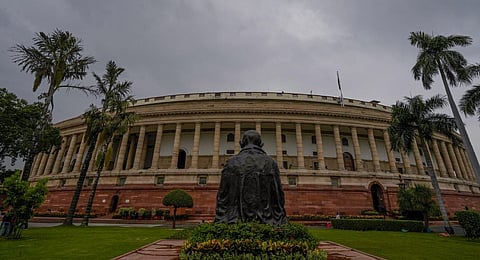

NEW DELHI: The passage of several crucial Bills after the acceptance of a no-confidence motion in the House has become a major bone of contention between the Opposition and the government.
At least 12 Bills have been passed and several others were introduced in both the Houses of Parliament after the Opposition parties moved the no-confidence motion against the government on July 26.
The Lok Sabha will take up the no-trust motion from August 8-10.
Speaking to this newspaper, RSP MP NK Premachandran, who raised the issue in LS, said that after acceptance of the no-confidence motion, any legislative business transacted by the House violates propriety. “It has been explicitly said in Kaul & Shakhdar, ‘Practice & Procedure of Parliament’, that when leave is granted by the Speaker for a no-confidence motion, no substantive motion relating to policy matters shall be brought before the House unless and until the no-confidence motion is disposed of,” said Premachandran.
Former Lok Sabha Secretary General PDT Achary said that though there is no rule stopping the House from passing Bills after the tabling of a no-confidence motion, it is against Parliamentary conventions. “The motion says that the House has lost the confidence in the government,” he said.

Opposition members also point out that the government has gone against ‘conventions’ to steamroll several contentious Bills such as ‘Forest Amendment Bill, Jan Vishwas Bill, Mines and Minerals Bill, Biological Diversity Bill and Multi-state Cooperative Societies Bill, without debate.
According to Chakshu Roy, head of legislative and civic engagement, PRS Legislative Research, LS records show that non-confidence motions have usually been taken up for discussion within a day or two of it being admitted.
“In a few cases when there was a gap for more days, legislation has been discussed and passed by Lok Sabha. The LS Speaker has ruled that there is precedent for such legislative measures and that the rules give 10 days for the discussion on the no-trust motion to begin,” said Roy.
While BJP members point out instances in 2018 and 1972, when Bills were passed despite pending ‘no-confidence’ motions against the then governments, Premachandran said that those Bills were passed after both the government and opposition reached a consensus.
Congress MP Manish Tewari terms such legislations as “constitutionally suspect.”
“On 26th July 1966, Satyendra Narayan Sinha, the then minister of parliamentary affairs, made a statement in Lok Sabha: ‘I do concede that whenever there is a no-confidence motion, no substantive motion should he brought just to forestall the whole thing.’ These are the parliamentary traditions that are being subverted by passing Bill after Bill when no-confidence motion has been admitted,” Tewari said.
While the Opposition MPs are mulling to move the court over Bills that have been passed since July 26, Achary argues that the House has the privilege to regulate its own business and the court cannot interfere.
Speaking to this paper, Congress Lok Sabha MP Gaurav Gogoi said that the rule book of Parliament clearly states that when a no-trust motion is admitted, no substantive policy can be discussed.