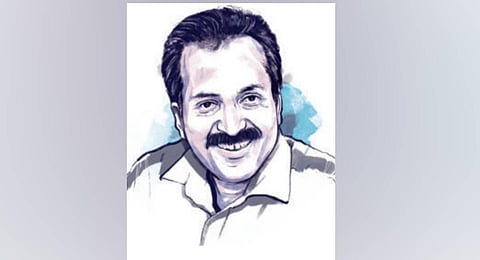

Our destiny is to be explorers, he had said in one of his TED talks while addressing the academia in his home state, Kerala.
On July 14, when Chandrayaan-3 was successfully launched at 2.35 pm from the Satish Dhawan Space Centre, SHAR, Sriharikota in Andhra Pradesh, the glint in his eyes and the smile on his face gave away a dream on its way to realisation. chairman of, the Indian Space Research Organisation (ISRO), Somanath Sreedhara Panicker is the man in whom rests India’s destiny to explore the unexplored regions of the moon — the South Pole — and become the frontrunner in space with more explorations and crewed missions.
In 2008, India’s first lunar mission Chandrayaan-1 first discovered water on the moon. Fifteen years later, after the historic finding, Chandrayaan-3 has been launched to soft-land at 70° to the South Pole to study the unknown, which has the potential to throw up ample data for space scientists and crewed missions.
“We have more scientific interest in this spot (South Pole) because the equatorial region, which is safe for landing, has already been reached and a lot of data is available for that. if we want to make a significant scientific discovery, we have to go to new areas such as the South Pole, but it has higher risks of landing,” Somanath said after Chandrayaan-3 launch. Four weeks from now, if the spacecraft successfully soft-lands on the moon on August 23, India will once again make history.
An aerospace engineer and rocket technologist, Somanath is an expert in the area of system engineering of launch vehicles. His contributions in PSLV and GSLV MkIII were in their overall architecture and propulsion stages of design, structural dynamics designs, separation systems, and vehicle integration.
“Somanath is a leader; an expert in rocket technology. He led the team in making the launch Vehicle Mark-IIIM4 rocket, the ‘Fat Boy,’ which launched chandrayaan-3. He is also an able manager. He leads from the front,” said a former space scientist.
Soon after the launch of chandrayaan-3 on Friday, Somanath stepped aside from the podium and asked the mission and project scientists — the hidden faces behind the third lunar mission — to step out and speak. He has enough patience to field questions and break down complicated space algorithms to the media.
He has urged scientific institutions in the country to identify talented students and motivate them to use the data emerging from science-based space missions effectively. “Space has traditionally been a government-controlled activity. To become a space-faring nation, we need the private sector/industry/start-ups to invest. ISRO can be an enabler in the paradigm shift,” he said in one of his interviews.
Somanath assumed charge as secretary of the Department of Space, and chairman of the Space Commission as well as iSRO on January 14, 2022, after succeeding K Sivan. He was earlier director, of Vikram Sarabhai Space Centre, Thiruvananthapuram, and has served as the director of liquid propulsion Systems centre, Valiamala, for two-and-a-half years.
Born in July 1963 to Sreedhara Panicker and Thankamma at Aroor in Alappuzha district of Kerala, Somanath studied at St Augustine’s School in Aroor and later did his graduation in mechanical engineering from TKM College of Engineering, Kollam. He is an alumnus of the Indian Institute of Science, Bengaluru, from where he did his masters in Aerospace Engineering, specialising in Structures, Dynamics, and Control, and was awarded the gold medal.
He joined VSSC in 1985 and was a team leader for the integration of PSLV during the early phases. His wife Valsala Somanath is with the Goods & Services Tax Department. the couple has two children, who have completed their professional education.
Besides monitoring cCandrayaan-3, Somanath is busy with the upcoming launches, most importantly Aditya l1, which shall be India’s first space-based mission to study the sun; NISAR (NASA-ISRO Synthetic Aperture Radar), an observatory in low-earth orbit that will fly two radars, one contributed by each country, to monitor minute changes in earth’s surface and the lunar polar Exploration, an India-Japan space mission to study water ice lingering in moon’s permanently shadowed regions.
“There are many possibilities. You can even travel beyond the solar system, and go to a planet in another solar system if you know how to go. it’s our destiny to be explorers.” He is living his talk.