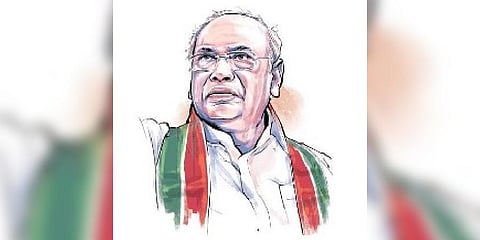

The man who barring once in his half-a-century political career has never tasted defeat is at the centre of the Congress sweep in Karnataka. The party has put up the second-highest score, 136 out of 224 seats. In 1989, the party secured an unprecedented victory in which it grabbed 179 seats. Veerendra Patil was at the helm, then.
Mallikarjun Kharge entered politics in 1969 as the town president of Gulbarga. He was a trade union leader. Son of a mill worker, he lost his mother and sister in 1948 when their house was set afire by the Razakars, Nizam’s army, at their village Varwatti in Bidar district. Kharge was playing near his house and his father was working in the field when the tragedy struck.
Kharge was born to Mapanna and Saibavva. He is married to Radhabai. The couple has five children, three sons and two daughters. Barring his one son and Chittapur MLA Priyank, the rest of his children stay away from politics and maintain a low profile. Priyank says his father expects his children to be aware citizens and have empathy.
The 80-year-old All India Congress Committee president Kharge is one of the last surviving Ambedakarites. He missed on three occasions the opportunity to become the CM of Karnataka.
He and former Congress CM of Karnataka Dharam Singh were great friends. Together, they were famous as Dharam-Karam of Karnataka politics. Kharge joined the Congress in 1969 paying 25 paise (chaar aana) as a membership fee, recalls an octogenarian resident of Kalaburagi, Mushtaq Khan.
He has taken the state back to the Grand Old Party from its formidable rival BJP with the major groundwork done by KPCC president DK Shivakumar and CLP leader and former CM Siddaramaiah. The trio worked as a team and put up a collective fight. The first list of nominees was issued first by Congress 45 days ahead of the polls.
Kharge knows the state politics like the back of his hand. The knowledge of the state; caste matrix and political manoeuvring greatly helped the central party leaders in identifying the right candidates for the assembly polls and minimized dissent during ticket distribution. He was the bridge between the central party leaders, especially the Gandhis and the state leaders.
Known for his hard work and commitment, Kharge didn’t leave Karnataka after April 14 - Ambedkar Jayanti day. “He worked for over 18 hours a day without a break, conducted 43 public meetings and travelled over 3,000 km across the state with eyes and ears to the ground. Towards the end of the campaign, on May 8, he had developed severe back pain but he told me that he has to reach out to the people to protect democracy),” said author Chetan Bhimrao Shinde, who along with the former chairman of the University Grants Commission (UGC), Dr Sukhdev Thorat has co-authored a compilation of over 70 articles titled, ‘From Nowhere to Up There: Political Journey of Compassion, Social Justice and Inclusive Development,’ to felicitate Kharge on his 80th birthday and 50 years of his political career.
Kharge is the third AICC president representing the Dalit community after Damodaram Sanjivayya and Jagjivan Ram (1970-71) and the first president outside the Nehru-Gandhi family after 23 years. Kharge has remained a Congress loyalist since his first election from Gurumitkal, Karnataka, in 1972 at the age of 27 years.
Kharge has won assembly elections a record nine consecutive times from 1972, 1978, 1983, 1985, 1989, 1994, 1999, 2004 from Gurumitkal, and 2008 from Chittapur (after delimitation). He contested for Lok Sabha from Gulbarga in 2009. He became labour minister for four years followed by railway ministry for one year. After UPA lost elections in 2014 he was appointed the floor leader in the Lok Sabha.
In 2019, he lost the LS poll from Gulbarga after which he was elected as the Rajya Sabha member in 2020 from Karnataka following the end of Gulam Nabi Azad’s tenure. When free from the humdrum of politics, Kharge’s love for reading and games, especially kabbadi and football, is well known. He prefers regional vegetarian food and is a stickler for time.
His socialist background and humble beginnings with personal tragedies at a very young age enhanced his ability to connect and empathise with the man on the street. A degree in law and ideological commitment towards Lokshahi has made him the solillada sardara (invincible warrior).