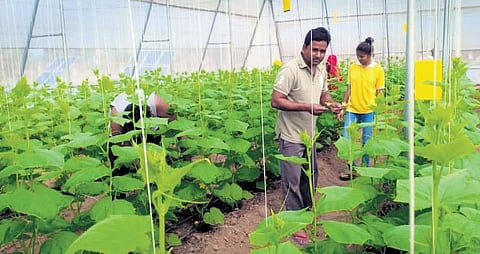

RAJASTHAN: Agriculture experts and enthusiast from across India love to congregate at Ramchandra Rathod’s farmland located in the Luni tehsil of Jodhpur district. Luni is a part of the Marwar region of western Rajasthan known for barren lands, and categorized as a dark zone because of polluted water. Despite some improvement in recent times, people in this desert region are forced to grapple with repeated droughts. Most youths have migrated to southern India in search of jobs.
In this challenging landscape, Ramchandra Rathod, a former tailor, has astounded many by successfully cultivating strawberries and broccoli in his ancestral land. Tomatoes from his farm are known to stay fresh for up to two months in the fridge. Ramchandra’s pioneering agricultural techniques have drawn the attention of global agriculturalists, many of them from Australia.
Recognizing his innovative efforts, he was appointed the brand ambassador of the Central Arid Zone Research Institute’s Innovations in Farming programme in 2018. Same year, he clinched the title of the best farmer in the Luni region for the exceptional produce. Last year, he became president of the Rohicha Cooperative Society, following a 10-year tenure as a director in the Cooperative Society from 2012 to 2022.

Through his innovations, he has inspired over 500 farmers from neighbouring areas, enabling them to access government schemes and learn advanced farming methods tailored for cultivating in drought-affected lands. Ramchandra grew up in challenging circumstances. His father, a farmer, faced recurrent crop failures due to insufficient rain, compelling Ramchandra to assist in farming rather than pursuing further studies. He turned to tailoring to support his family and continued his education up to the 12th grade through self-financing.
However, after his father’s death in 2004, he decided to transition back to farming on his ancestral land. “My father was very ill. His treatment drained our finances; we were in huge debt. I had to leave my studies. When my father died, I was only 17 years old. I decided to shift back to farming,” recalled Ramchandra. Initially engaged in cultivation of moong, millets, and jowar, Ramchandra faced water quality issues when a tube well was installed in 2018, providing highly polluted and unsuitable water for farming due to a TDS (total dissolved solids) reading of 42, significantly below the optimal range between 300 to 600.
The turning point came when he got an opportunity for a seven-day training at the Jodhpur CAZRI Institute, a part of the government’s Krishak Mitra scheme. This training taught him how to conserve rainwater for agriculture and employ innovative agricultural practices in desert conditions.
The training also introduced him to a series of government schemes supporting farmers. This further led him to challenge his belief that famine and unseasonal rains were insurmountable problems. Through the guidance of agricultural scientists and the practical knowledge gained from the training, he discovered the potential of rainwater harvesting and the protective benefits of polyhouses against erratic weather patterns.
Encouraged by a horticulture department official in Jodhpur, Ramchandra established a polyhouse in 2018. He expanded his efforts, installing a farm pond and a vermi-compost unit in 2019-20. By harnessing rainwater for cucumber cultivation in the polyhouse, he achieved a record-breaking yield of 14 tonnes in just 100 square meters, a feat unmatched by any single farmer in Jodhpur district.
Continuing his streak of innovation, Ramchandra ventured into cash crops, successfully growing strawberries and zucchinis in the desert area. His integrated approach involves rainwater storage in tanks and ponds, serving domestic and agricultural needs.
He also pioneered organic fertilizer production while dedicating a significant portion of his land to horticulture farming. His wife serves as a Ward Panch, reflecting the family’s active involvement in community leadership.
His success story has caused a ripple effect, inspiring other farmers to adopt similar practices. “We’ve harmonized ancestral agricultural wisdom with science, establishing a new farming methodology that nourishes the plants, not just the land. This shift has significantly improved our income, allowed our children to attend school, and reignited interest in farming among the youth,” says Ramchandra. Today, Ramchandra’s income has become much better; his children are studying in good schools, and many people are being drawn to farming.
“I tell the youth not to run after jobs nor migrate. I provide training to those who have no future in jobs. Those who migrated 20 years ago have started returning,” he says. With a vision for collective progress, Ramchandra has established a Farmer Producer Organization (FPO) to support fellow farmers looking to innovate their agricultural practices.
“Rajasthan receives meager rain and the groundwater depletion is a major cause for concern. If we can teach our farmers to conserve rainwater and utilise every drop of it, our state can surely flourish. I earn Rs 6 lakh in a year and I am putting all my efforts to improve the financial condition of other farmers of my region,” Ramchandra said.
Ramchandra Rathod is integrating rainwater harvesting with the agricultural needs of the arid land, pioneering organic fertiliser production while dedicating a significant portion of his land to horticulture, writes Rajesh Asnani