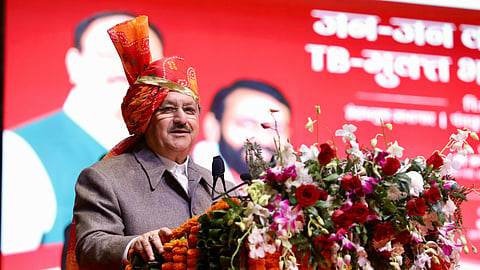

NEW DELHI: Union Health Minister JP Nadda on Saturday said the rate of decline of tuberculosis incidence in India has doubled since 2015 and is ahead of the global average.
Speaking at the inauguration of a 100-day nationwide intensified campaign in Haryana’s Panchkula to reduce TB cases and mortality, Nadda said, “We will take detection, tests, treatment and supportive strategies forward at a fast pace under this programme.”
The 100-day campaign will be implemented in 347 districts of 33 states where the prevalence of tuberculosis is higher.
The campaign is focused on enhancing detection, reducing diagnostic delays and improving treatment outcomes.
India, which tops the list of 30 countries with high-burden TB cases, aims to eliminate TB by 2025, five years ahead of the target set by SDG.
Nadda highlighted the country’s long struggle in its fight against tuberculosis, saying that at one time TB was considered “slow death”. “Even family members suffering from TB were isolated to prevent its spread. Since 1962, there have been many campaigns against tuberculosis, but in 2018, the Prime Minister put forth a vision to end TB much before the 2030 deadline of the Sustainable Development Goals,” he said.
“We changed strategies to achieve the aim. Services have been decentralised and now, 1,73,000 Ayushman Arogya Mandirs will have the facilities to detect and treat tuberculosis,” the minister said.
He also said molecular technologies have been introduced for TB detection. Also, a new and shorter regimen of tuberculosis treatment has been started to help increase compliance and fight TB, he said.
Nadda highlighted that the rate of TB incidence decline in India has doubled from 8.3 per cent in 2015 to 17.7 per cent now, which is much ahead of the global average. TB deaths have also reduced significantly in India by 21.4 per cent in the last 10 years, he said.
“Ni-kshay support worth Rs 3,338 crore has been provided through direct benefit transfer to over 1.17 crore tuberculosis patients,” Nadda said, underscoring that the government has increased Ni-kshay poshan amount from Rs 500 to Rs 1,000 and added energy boosters for the nourishment of patients.
