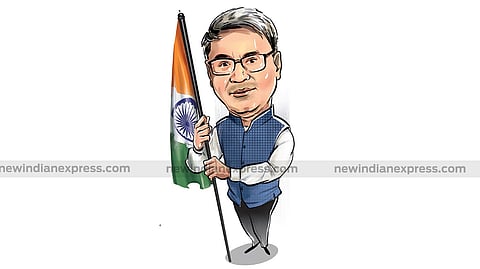

Those who know Vikram Misri in the Ministry of External Affairs say the new top diplomat is progressive, forward-looking, and well-versed with not only the internal exigencies of the current dispensation but also their diverse nuances expressed outside India’s borders.
Misri, before assuming charge as the foreign secretary, was the deputy national security advisor and, before that, the ambassador in Beijing. The combo of experiences could have qualified him to be called the “China expert.”
More so, as the Galwan clashes in eastern Ladakh took place during Misri’s ambassadorship in Beijing. At least 20 Indian soldiers were martyred in a deadly skirmish with the Chinese PLA (People’s Liberation Army) troops, who too suffered an unspecified number of casualties at the Himalayan peaks.
“With continued communication at all levels—political, diplomatic, and military—the two sides would be able to resolve the current difficulties and take the relationship forward in a positive direction,” Misri told China’s Foreign Minister Wang Yi before returning to India in December 2021.
During the same conversation with Wang, Misri said that the India-China relationship comprised both opportunities and challenges, even though certain challenges in 2020 had overpowered opportunities in the relationship.
Misri’s other unique qualification is that he has served three prime ministers of different political shades as private secretary—IK Gujral (1997–1998), Manmohan Singh (2012–2014), and Narendra Modi (May to July 2014).
True to India’s commitment to the ‘neighbourhood first’ doctrine, Misri has embarked on his first overseas visit to Bhutan within three days of assuming charge.
Bhutan is crucial for India as it had resumed border talks with China during the previous government. However, the new government under Prime Minister Tshering Tobgay seems favourable towards India. Misri met the king of Bhutan, the Prime Minister, and his counterpart during his visit and also co-chaired development cooperation talks between the two countries.
Born in Srinagar, Misri, 59, is a 1989-batch Indian Foreign Service officer and succeeded Vinay Mohan Kwatra on July 15. Misri holds a bachelor’s degree in history from Delhi University’s Hindu College and an MBA from XLRI Jamshedpur.
Three years before making it to the foreign service, Misri worked in the advertising sector at Lintas in Mumbai and Contract Advertising in Delhi.
He has worked at the Ministry of External Affairs’ Pakistan desk and also with two former external affairs ministers, Pranab Mukherjee and IK Gujral. He has had stints in the Indian missions in Belgium, Pakistan, the US, Sri Lanka, and Germany.
One of the biggest challenges that stares Misri in the face is maintaining India’s diplomatic stance of “strategic autonomy," which until now has enabled India to balance its ties with the US-led West and Russia.
On July 11, US Ambassador to India Eric Garcetti said that there was no such thing as strategic autonomy in times of conflict. “We will, in crisis moments, need to know each other. I don’t care what title we put to it but we will need to know that we are trusted friends,” said Garcetti.
This fallout primarily stems from India’s resistance to condemning Russia’s invasion of Ukraine. Meanwhile, the ties with China are at a low against the backdrop of a tense Line of Actual Control, despite several rounds of talks to bring about a thaw.
In the neighbourhood, Misri’s stint in Myanmar (2016) will hold him in good stead while he decides how to tackle the junta government, which has been in turmoil, leading to an inflow of thousands of Myanmarese refugees into India.
