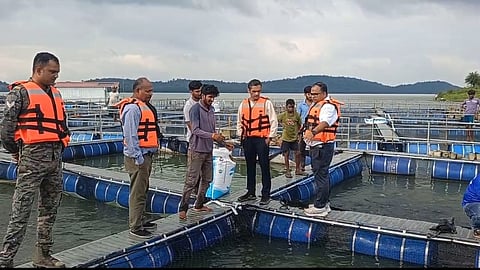

JHARKHAND :There was a time residents of the 56 villages under the Barhi block of Hazaribagh had to venture far away in search of jobs. But they are now finding new opportunities in the waters of Tilaiya Dam, which had submerged their homes back in 1956.
Though the construction of the dam had displaced them, they are now leveraging its waters to earn a living through cage culture, all thanks to the state government’s District Mineral Foundation Trust (DMFT) and the Pradhan Mantri Matsya Sampada Yojana (PMMSY).
According to officials, more than 2,000 households are engaged in fish farming, either directly or indirectly, in the area. “The farmers living near the reservoir, whose land was submerged during the construction of the reservoir, are now shaping their future with the help of fish farming in the same water,” said Hazaribagh District Fisheries Officer Pradeep Kumar.
Fish farming has not only given them livelihood opportunities but also deepened their emotional attachment with their farms, he added. “Further, it has significantly improved their social and economic conditions,” Kumar said. Thanks to the job opportunities created by government schemes, migration to other cities in search of jobs has drastically come down.
But how did it all begin? Small welfare schemes launched by the state government aided farming through cage culture in the Tilaiya Dam. Initially, it was challenging for the authorities to convince villagers to adopt modern techniques of fish farming. But as time passed, they adopted it.
“The benefits of these welfare schemes grew with cooperation from the state government and district administration through the DMFT fund. But it was the implementation of the PMMSY that brought about a revolution in the lives of farmers,” said Kumar. As there was no cap on the number of beneficiaries, many people applied and benefited from it.
Ask Dinesh Sao (35) of Bendgi village in Barhi Block how the government efforts helped turn his life around, and pat comes his reply, “Since I did not have any source of livelihood here, I had to move to Ramagundam in Telangana and work as a JCB operator to earn my daily bread. After working there for a few years, I got married and started looking for opportunities near home.
Incidentally, that’s when this whole concept of fish farming took root here. That proved a turning point.” Initially, he was given one cage, helping him net a significant profit. It prompted him to seek more cages on behalf of his family members. “With seven cages, I make around `5 to 8 lakh in a year,” Sao shares.
Another beneficiary of the PMMSY, Pintu Kumar Yadav (31) of Bundu village in Barhi, was drawn to fish farming when he used to work as a truck driver in Rajasthan. Having delivered huge consignments of fish as a driver, he realised how profitable the business was. He returned to his village in 2017, bought fish seeds worth Rs 5,000 and placed them in a pond. Yadav ended up with a profit of Rs 50,000.
Just like Sao and Yadav, many other households have benefited from government support for the practice. As many as 2,409 cages have come up in the Tialiya Dam, the highest in Jharkhand. And the sector is only growing further.
