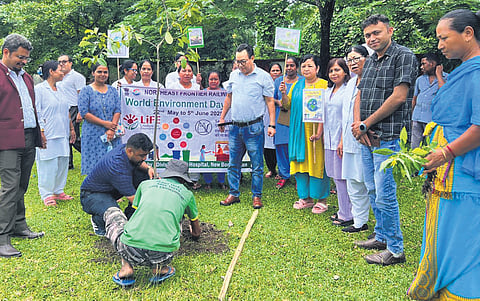

Plant trees, not saplings”—that is the motto Assam’s 59-year-old Uttam Kumar Das lives by. In the process, the railway employee has achieved a rare feat: not a single tree he planted has died in the last one decade.
There is growing awareness about planting trees as the planet heats up, but most plantation drives end in disappointment. In Assam, official data shows that saplings planted under the Compensatory Afforestation Fund in 2023-24 had a survival rate of about 83.75%. Along national highways in 2024-25, survival was just above 82%. In contrast, Das has achieved near-total success, not by joining campaigns but by changing the way he plants.
His journey began with personal loss. In 2008, his five-year-old son was diagnosed with a terminal illness. He took him to Bengaluru for treatment. However, chances of recovery dwindled, and he died last year at 21.
“He was my only child, a brilliant boy who always did well in school. The disease was detected in Class 5. I took him to Bengaluru with hope. But when doctors said nothing more was possible, I returned broken. His illness kept him confined to bed, and he could no longer study,” Das recalls.
While in Bengaluru, something else caught his eye: the city’s greenery. The tree cover stayed in his mind long after he returned. On World Environment Day that year, still grieving but determined to keep moving, he planted a few saplings outside his office in Bongaigaon. That small act became a habit.

Over the years, he planted thousands of trees in and around Bongaigaon and in parts of lower Assam. From 2008 to 2011, he planted saplings with guards and nets wherever he could. However, 80% of them died—eaten by cattle or lost to neglect and lack of maintenance. The numbers were discouraging.
“I realised something was wrong in the method. Saplings are too fragile. I stopped planting altogether for two years to rethink,” he says.
Back in the year 2014, he started a nursery in the backyard of his railway quarters. He planted saplings in large polybags and plastic drums, using only vermicompost. He let them grow for two to three years until they reached six feet or more. Only then did he plant them outside.
Soon, the survival rate shot up. “Not one sapling grown in my nursery has died in the ground,” he says. His approach became simple: don’t plant saplings, plant trees. He chose hardy and native species—Arjuna (Terminalia arjuna), Banyan, Gulmohar (Royal Poinciana), and several fruit trees.
Today, many of those trees are big and full of life. The fruit trees bear mango, Indian blackberry, jackfruit, and olive. “I feel happy when I see hawkers and small traders sitting under their shade. Rickshaw and cart pullers rest under them in the summer. Birds have built nests. Most of these trees are in New Bongaigaon,” he says.
Now, he collects seeds from these trees and grows new ones. His wife helps him in the nursery, and he occasionally hires labourers to assist. He spends 10–15% of his salary on maintaining the nursery.
Some people have come forward to help. “They contribute when they can. Society knows what I am doing,” says Das.
His work has been recognised with awards from the railways and the district administration, though he doesn’t seek attention.
He has a message, and it is blunt: “Everyone of us has to act to keep the earth healthy. It is unwell because of us. We are more educated, but we cut trees. Ponds are disappearing. We choose concrete over nature.”
He calls it not global warming but “global warning”, and says danger is close. “Coronavirus warned us to correct ourselves. We have to protect the environment. We need more ‘oxygen banks’ around us. We can create them by planting trees.”
He plans to plant even after he retires. That has become his way of grieving, healing, and giving back.