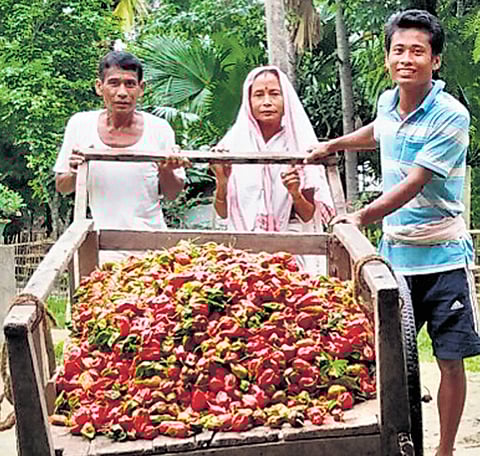

ASSAM: Nabanidhi Gogoi’s journey is one of grit, resilience and an unwavering commitment to transforming adversity into opportunity. Born in the remote village of Teok Boloma Moran Gaon in Jorhat district, Assam, he became familiar with poverty early on.
As the eldest of three siblings, Gogoi’s family struggled to make ends meet, and he was exposed to farming from a young age, helping his mother sell vegetables to fund his schooling. Little did he know then that these early experiences would lay the foundation for a remarkable story of personal triumph and community impact.
Childhood Shaped by Hardship
Gogoi’s childhood was far from easy. His father, who was unable to contribute financially to the family, left his mother to shoulder the responsibility of raising the five-member family. Every morning, his mother would wake up early to gather “dhekia” (fern), “kachu” (yam), and “kalphul” (banana flower), which he would sell at the local market. Despite the challenges, Gogoi’s mother instilled in him a strong work ethic and an understanding of the value of hard work.
After completing his Class 12, Gogoi faced a difficult decision. He needed Rs 200 for his college admission, but his mother could not afford it. With two younger brothers also in school, the financial strain was unbearable. “In 2001-02, I set out for Delhi to work at a company but returned home two months later after not liking city life. I thought if I were to build a future, it had to be through my own efforts, not by relying on others,” says Gogoi. And so, he turned to agriculture.

Turning Point
In the beginning, he leased land from his neighbours to expand his agricultural ventures. Slowly but surely, he began to see success. However, the road was far from smooth. In 2006-07, financial constraints forced him to sell some of his agricultural land to fund the higher education of his brothers, who were pursuing their studies in Guwahati and Dibrugarh. He made an agreement with the buyers that if they ever decided to sell the land, they would offer it to him first. With time, Gogoi repurchased the land and reinvested in his farming business. His persistence began to pay off, and over time, he expanded his agricultural activities, growing a variety of crops and even starting a piggery.
Agricultural Innovation
Today, Gogoi’s 22 bighas (13.6 acres) of land is a thriving agricultural hub. He grows a variety of vegetables, including seasonal crops, and has ventured into horticulture. He also runs a piggery, which began in 2018 with three piglets received from a Krishi Vigyan Kendra. Now, his piggery houses nearly 100 pigs.
“Pig farming is not well received in our region, but the villagers were very supportive. I assured them I would do it as a business, and they didn’t object as long as I ensured it didn’t cause any inconvenience to them,” says Gogoi. His daily expenses on pig feed amount to about Rs 4,000, supplemented by vegetable leaves from his farm. He employs two workers for the piggery and four others for agricultural tasks, hiring additional labourers as needed.
Renowned Assamese litterateur Homen Borgohain had visited Gogoi multiple times and written about his achievements. Government officials and agricultural research institutes have also taken notice, with students from these institutes visiting his farm to learn about his methods.
‘Krishi Ghar’
Today, Gogoi’s home is not just a farm; it has become a centre for agricultural innovation and education. He has converted a room in his house into a “Krishi Ghar,” where he discusses farming techniques with students, farmers, and government officials. His agricultural practices have caught the attention of many, and his farm has become a destination for practical learning.
“Many agricultural students from various institutes visit me for training. In one instance, 40 students came for field research, and the villagers hosted them,” Gogoi recalls. “I feel immense pride when university professors call me to share my knowledge with their students. It’s a recognition of the journey I’ve undertaken,” he adds.
Over time, Gogoi has also developed a deep understanding of soil health and crop suitability, enabling him to predict with accuracy which crops will thrive in his region. He regularly shares this knowledge with other farmers, encouraging them to diversify their crops based on seasonal changes rather than relying on a single crop.
Giving Back to the Community
In addition to his agricultural work, Gogoi’s success has had a ripple effect on his family and community. Both of his brothers have secured government jobs after completing their post-graduate degrees, and Gogoi played a crucial role in pushing them toward those careers.
“I encouraged my brothers to take up government jobs. Our village only had one government employee at the time, and I wanted my brothers to set an example,” says Gogoi.
Talking about his future plans, he says his effort would be to develop a work culture among the youths of his village. “My biggest satisfaction is that I have earned a name for myself. Go anywhere in Jorhat district, farmers will take my name. I am happy that society has recognised my efforts. I consider it as my greatest award,” he says.