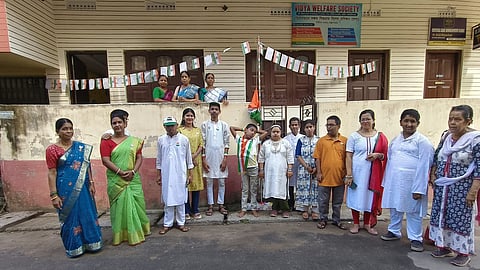

TRIPURA : For 22 years, Dr Ratnabali Ray Sengupta of Tripura has been running a school for autistic children. What began as an effort to educate her own son evolved into a social initiative that has helped many children with special needs.
Ratnabali teaches at Women’s College, Agartala. She founded the Vidya Welfare Society in 2004 to support and empower individuals with intellectual and developmental disabilities, including autism, Down syndrome and related conditions. The society provides education and skill-based training, along with therapeutic interventions based on individual needs.
Recalling the society’s foundation, Ratnabali says she was distressed and confused about her son’s future, wondering how and where she could provide him with proper training and secure his prospects. She went to Kolkata and admitted him to a special school. However, the school advised her to establish one in Agartala for her son and other children with special needs, as regular travel between Agartala and Kolkata would be difficult to manage.
So, she mobilised acquaintances, well-wishers and parents and established ‘Vidya’ with their support. She is the honorary principal of the school, which currently has 25 students, including four girls, and is run by the Vidya Welfare Society.
Before establishing the school, she visited several special schools in Kolkata, drawing on their experiences and incorporating the best practices into her institution. Her firsthand understanding of her son’s challenges and needs proved invaluable in developing and shaping the school.
Ratnabali says all expenses involved in running Vidya, including training and services, are primarily borne through contributions from parents. Over time, many socially committed and well-wishing members of the community became associated with the institution.
“We have many parents who are economically disadvantaged and are unable to pay the full fees. This makes it quite difficult for us to run Vidya.

Although we manage to meet many of our expenses through our own efforts, we still face financial constraints in several areas that we are unable to fully overcome,” she says.
Having built the organisation from the ground up, Ratnabali and her husband remain profoundly connected with it. “All the autistic children at Vidya are trained with great care and affection, and treated with love and compassion, almost as if they were being cared for by their own mothers,” Ratnabali says. The society primarily appoints female teachers who train each child with patience, affection and dedication. Children who are highly hyperactive are handled systematically and appropriately, following established professional methods. The guidelines and standards prescribed by the Rehabilitation Council of India are strictly followed.
The society also undertakes skill-development programmes to help the children become self-reliant and secure sustainable livelihoods in the future. It carries out all activities at its own expense and has not received any financial assistance from the government so far.
It envisions establishing a residential home and creating a trust that will provide these individuals with long-term financial security, proper care and a dignified life.
“The Vidya Welfare Society believes that every child, irrespective of disability, possesses unique abilities, potential and dignity. Our approach is rooted in love, acceptance, patience and respect, rather than sympathy or pity,” Ratnabali says.
She says the society strives to enable them to develop their communication, social, emotional, behavioural and functional skills at their own pace.
“We believe that autism should never be a barrier to a child’s right to learn, grow, participate and lead a meaningful life. Our aim is not merely to provide education and therapy, but to prepare every child for greater independence, self-confidence and social inclusion. Through individualised training, special education, therapies, skill development and continuous parental involvement, we work towards bringing out the best in every child,” Ratnabali says.
The society aims to ensure that no child is left behind because of disability. Ratnabali faced numerous challenges while establishing Vidya, with the first and foremost challenge being a lack of funds. Setting up a school requires substantial financial resources, and arranging the funds was a major struggle for her.
She says that she is facing financial constraints even today. “We have children coming from families belonging to different economic backgrounds, and we always try to reduce the financial pressure on their parents. We believe that every child deserves care, education, therapy, and opportunities, regardless of whether their family is rich or poor,” says Ratnabali.
Another major challenge is finding suitable accommodation for the school. She laments that society does not always understand the needs and behaviour of children with intellectual and developmental disabilities. Many people are reluctant to rent their houses or properties for such a school. “These children may sometimes make sounds, become restless, or create a little noise.
A special school also requires a reasonably large space because the children need classrooms, therapy areas, activity spaces, and room for movement. At one point, Vidya Welfare Society was functioning from a large rented house. However, due to objections from people in the surrounding area, we were compelled to leave the premises. As a result, finding an appropriate and sustainable space has become another major challenge for us,” she adds.
Her journey as the mother of an autistic child has deeply influenced the way she works with the children. When her child was diagnosed with autism, she experienced many emotions, including confusion, fear, helplessness, and uncertainty about the future. She realised how difficult it was for parents to find accurate information, understanding, education, therapy, and acceptance for their children.
From a mother's worry to a school
When her son was diagnosed with autism, Dr Ratnabali Ray Sengupta struggled with uncertainty over his future. She travelled to Kolkata to find him a suitable school, but was advised to establish one in Agartala instead. In 2004, she founded the Vidya Welfare Society with the support of parents, friends and well-wishers. Today, its school has 25 students and offers special education, therapy and skill development, helping children build confidence, independence and dignity.
Beyond education
The society’s work extends beyond classroom learning. Children receive individualised special education, therapeutic interventions and skill-based training aimed at improving communication, social, emotional, behavioural and functional abilities. The school follows guidelines prescribed by the Rehabilitation Council of India and involves the parents of the children closely.
Need for space
Funding remains a challenge for the school, particularly as some families cannot afford full fees. Finding suitable premises is another hurdle. The school needs spacious classrooms, therapy and activity areas, but the institution had to relocate over neighbours’ plaints.