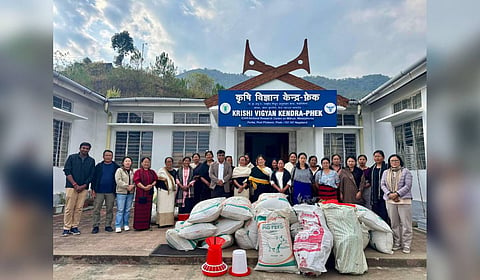

NAGALAND: When everything becomes seedless, it will be the death of agriculture. Nagas are well known for their agricultural wisdom and their love for everything “local”. It is no surprise, then, that a community-based initiative in Nagaland’s Phek district, bordering Myanmar, is centred on a seed bank—one remarkable for both its scale and purpose.
The Chizami Community Seed Bank is a repository of more than 200 indigenous seed varieties, including rice, maize, ricebean, foxtail millet, millets, perilla, pulses and vegetables. Many of these are prized for their unique taste and flavour.
Traditionally, seeds were preserved and exchanged informally among households, ensuring the continuity of diverse crops and the knowledge systems associated with them. However, the increasing spread of hybrid and market-based seeds, coupled with climate change, biodiversity loss and changing agricultural practices, prompted the community to systematically conserve its indigenous genetic resources, strengthen food, nutritional and ecological security, and promote sustainable, climate-resilient farming systems.
This led to the establishment of the Chizami Community Seed Bank in 2018 by the Chizami Women Society. The seed bank is deeply rooted in women-led collective action, reflecting Chizami’s broader development model in which women play a central role in livelihoods.
A committee, comprising mostly women, manages the seed bank, which serves as a community institution supporting farmers through seed sharing, multiplication and awareness-building activities. It operates on a traditional lending model under which farmers borrow indigenous seeds and return them after harvest in greater quantity. For instance, a farmer borrowing 100 grams of seed must repay 200 grams, ensuring sustainability and continuous seed multiplication.

The seed bank emerged from the convergence of traditional knowledge, women’s collective leadership, and need for biodiversity conservation and climate resilience, making it a model for community-led seed sovereignty in Northeast. Welhizou Wetsah, in-charge of the seed bank, credits local NGO North East Network and Indian Council of Agricultural Research–Krishi Vigyan Kendra (ICAR-KVK), Phek, for support.
“We had little understanding of seed banks until the North East Network educated us. The NGO advised us during a meeting in 2018 to establish a seed bank to preserve our crop heritage, saying that if we did not preserve our traditional crops, they would be lost one day,” Wetsah tells this newspaper. Soon after, village women, village authorities, students, members of the Village Defence Party and other villagers came together to establish the seed bank.
“We are preserving more than 200 varieties of seeds from organically grown crops. Over 40 of them are rice varieties,” says Wetsah. Housed in the office of the Chizami Women Society, the seed bank has little room for expansion. The community hopes the government will help build a permanent facility for its long-term sustainability.
“The biochemical profiling of indigenous rice landraces will facilitate the identification of nutritionally superior and desirable varieties, enabling their integration into the value chain through value addition, packaging, branding and marketing by the Chizami Seed Bank Self-Help Group,” says Dr Sanjeev Kumar Singh, Senior Scientist and Head (Genetics and Plant Breeding), ICAR-KVK, Phek.