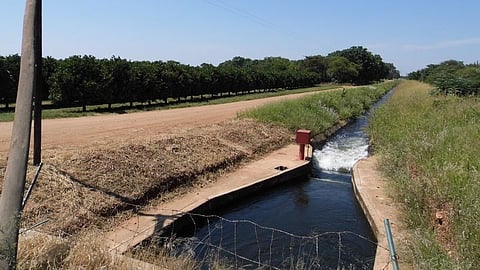

NEW DELHI: To encourage farmers to adopt precision irrigation technology and transition to water-efficient crops, thereby avoiding flood irrigation and over-irrigation, a government-funded body led by the Director General of the Indian Council of Agricultural Research (DG-ICAR) has recommended establishing a pricing system for water supply in canal commands.
This proposal suggests that farmers should be charged based on their water usage rather than receiving it at little to no cost or at a fixed rate.
The 146th policy paper titled “Water Security: Is Quantum or Management the Issue?” emphasises, “Switching over to precision water management is vital. It can start with the fixing of the price of water supply in the canal commands and use of IoT-enabled digital water-measuring devices or the canal-automation gadgets to ensure volumetric supply as per crop water demand.”
“This will encourage farmers to minimise waste and adopt water-saving practices,” stated Dr ML Jat, DG of ICAR and currently head of the National Academy of Agricultural Sciences, an independent advisory body funded by the Ministry of Agriculture and Farmers’ Welfare.
Dr Jat further emphasised the need for an institutional mechanism for water budgeting at the farm, community, and command levels to incentivise farmers who adopt water-efficient irrigation technologies. He shared insights from a similar pilot project conducted in Punjab a few years ago, in partnership with the World Bank, which aimed to motivate farmers to use electricity and water more efficiently.
The policy paper concluded that the availability of water resources in the country is not the main issue; rather, effective management using proven technologies is essential.
Additionally, the paper recommends collaboration between governments and private companies to introduce technology, investment, and innovative services into irrigation systems, enabling farmers.
Other recommendations include bridging the gap between the irrigation potential created and its actual utilisation through underground pipeline irrigation, modernising canal commands, adopting micro-irrigation systems, and encouraging crop diversification.
Furthermore, the paper advocates for the establishment of an institutional mechanism for the payment of ecosystem services or green credits to farmers who adopt water-efficient technologies and successfully reduce their water consumption.
It also suggested that the concept of virtual water be re-examined in future planning programs and promote the use of treated wastewater in agriculture.
