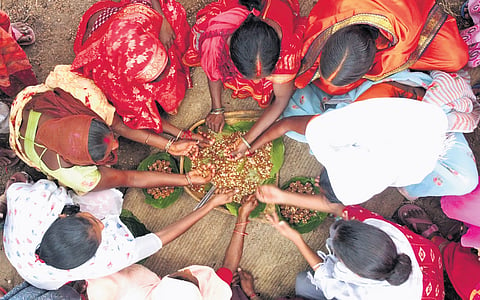

An initiative by the Palamu Tiger Reserve (PTR) management is transforming the livelihoods of forest-dependent communities while strengthening conservation efforts in the reserve’s core areas. By introducing a scientific mahua flower collection system, PTR has significantly improved the quality of the produce, doubled villagers’ earnings and reduced the incidence of forest fires.
The initiative was launched in recognition of mahua’s deep cultural, nutritional and economic significance among tribal communities. Despite being a traditional staple food rich in dietary fibre and nutrients, mahua consumption has gradually declined over the years, while collectors have continued to receive poor returns for their produce in the market.
Mahua flowers, which begin falling from trees across Jharkhand from March onwards, remain an important source of income for thousands of forest-dependent families. Traditionally, villagers collected the flowers from the ground, where they were often contaminated by soil, dust and animal waste, affecting both quality and market value and making it difficult to produce hygienic, food-grade mahua products.
To address the problem, PTR introduced special agro-nets beneath mahua trees. As the flowers fall naturally during the flowering season, they are collected directly onto the nets, ensuring cleaner, higher-quality produce. The intervention has also helped tackle one of the reserve’s most persistent conservation challenges—forest fires.
“Earlier, villagers would burn dry leaves beneath mahua trees to facilitate easier collection of flowers, a practice that frequently triggered forest fires. Over 90% of forest fire incidents in the reserve originated from areas around mahua trees,” said PTR Deputy Director Prajesh Kant Jena.
“With the introduction of collection nets, there is no longer any need to burn leaves, reducing the risk of forest fires while also saving time and labour,” he added.

“Under the new system, mahua flowers that naturally fall onto the nets are first dried on the nets themselves and then transferred to raised platforms for sun-drying over 3–4 days,” said Jena. “This method ensures that the flowers remain clean and attain food-grade quality.”
Earlier, villagers usually dried mahua on roadsides or bare ground, often compromising its quality. The improved drying process has significantly enhanced hygiene standards and product quality. Interestingly, many villagers were surprised to see the flower’s actual colour for the first time, as mahua collected from the ground often appeared dirty and discoloured. The impact on incomes has been equally significant. While collectors earlier sold mahua for `30–35 per kg, food-grade mahua is now fetching around `80 per kg, increasing household earnings by at least twofold. According to Jena, poor-quality mahua rarely finds its way into food products.
“If the quality of mahua is bad, it will never be used in food and will ultimately be used for brewing country-made liquor, fetching a very low market price. Mahua should not be viewed through the lens of stigma or taboo that has often surrounded it,” he said.
The initiative has also reduced risks associated with prolonged human presence inside forests.
“Earlier, people used to stay in the forests for long hours, and there were chances of man-animal conflict. Most of the tiger attacks have taken place during the early morning or late evening, when people were out in the jungles collecting mahua,” said Jena.
The new collection system has also eased the burden on women and children. Earlier, mahua collection was a labour-intensive, family-wide activity that often kept children away from school throughout the season. “As it does not require labour anymore, only one person can go and collect mahua without involving the children,” Jena said.
To revive mahua’s traditional place in local culture and livelihoods, PTR organised a Mahua Festival as the culmination of the initiative. Elderly community members knowledgeable about traditional mahua-based recipes were invited to prepare and showcase local dishes. Private buyers and entrepreneurs involved in the mahua trade also participated in the event to explore value-added products and discuss mahua’s growing potential in national and international markets.
“The festival served as a bridge between tradition and enterprise. Community elders gained insights into modern mahua-based products, while private stakeholders developed a deeper appreciation of the cultural significance and culinary heritage associated with mahua,” said Jena.
Procurement of mahua is being facilitated through Eco-Development Committees formed by PTR and comprising villagers themselves. The committees are also responsible for distributing and collecting the agro-nets.
For beneficiaries, the impact has been immediate and visible. “The nets installed by the Forest Department make collection easy; a task that once took two to three hours is now completed in just ten minutes. Additionally, the mahua remains protected from dust, soil, and livestock,” said Kiran Kumari, a resident of Chhipadohar village inside the reserve.
While mahua was traditionally boiled or consumed in forms similar to sattu, villagers are now being informed about its potential use in products such as chocolates, cookies and other value-added items, she added. Another beneficiary, Lalmuni Devi of Bagh Tola, said mahua collection was once an activity that required the participation of the entire family.
“Now, my children no longer have to skip classes. With this scientific method, collecting mahua takes barely 10 minutes, whereas earlier it would consume the entire day,” she said.
The new system has also increased yields, as fewer flowers are wasted or eaten by cattle and goats before collection, she further added.