
On weekdays, Obing Siboh navigates the rugged terrain of Arunachal Pradesh’s remote Upper Siang district, driving a government vehicle to ferry healthcare workers on field assignments. Off duty, he is on a different mission: saving the Himalayan cherry and preserving the cultural heritage of his Adi community.
Born in Gobuk village, the 37-year-old has emerged as a grassroots conservationist, leading efforts to revive the region’s indigenous cherry trees while promoting wildlife conservation and traditional Adi games, songs and customs.
Arunachal Pradesh’s high-altitude regions offer ideal conditions for the Himalayan cherry, known locally as dikong appun. The species is found in areas such as Tuting, Gelling and parts of Upper Siang inhabited by the Memba community.
Siboh’s fascination with the tree began in childhood when he heard stories about a remote grove located nearly 15 kilometres from his village. The curiosity stayed with him for years until 2022, when he and his father undertook a demanding trek to find it. “I was mesmerised,” Siboh recalls. “There were around 50 to 60 trees, which I estimated were 60 to 70 years old. I marked some of the flowering trees and returned a month later to collect seeds.”
Convinced that the ageing trees needed protection, he began raising saplings in a nursery at his home, funding the initiative himself. As the plantations expanded, the Gobuk Welfare Society stepped in to help finance fencing to protect young saplings from grazing cattle.
The effort soon gained momentum. Plantation drives were organised across the village, including along the highway that passes through Gobuk, inspiring more residents to participate.

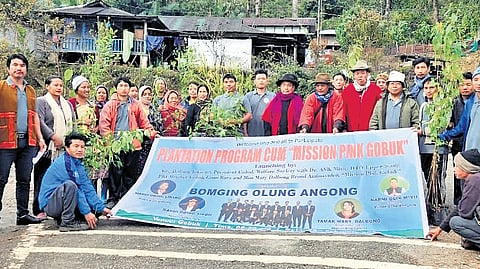
In 2024, Siboh’s age-based friendship group, Bomging Olung Angnong, organised a large-scale plantation drive, planting 1,500 saplings from his nursery. Villagers continue to maintain the plantations, and some of the earliest trees have already begun flowering.
“Our cherry blossoms are distinct, though they belong to the same family,” says Siboh, a graduate who joined government service as a driver in 2019 and is currently attached to the District Hospital in Yingkiong.
Initially, he feared the remote grove was the only place in Arunachal where indigenous cherry trees survived.
“I thought that once those old trees died, cherry blossoms would disappear from the state,” he says. Support from well-wishers helped sustain the movement. Although the Forest Department was unable to fund the project, former Divisional Forest Officer Annying Boli later donated `40,000 after retirement. Dr Ahik Miyo of the District Hospital and advocate Dubom Tekseng contributed `15,000 each. So far, Bomging Olung Angnong has planted more than 3,000 saplings.
Siboh currently nurtures around 4,000 more in his nursery and plans to distribute them to individuals and organisations genuinely committed to plantation efforts. Beyond tree conservation, he is also raising awareness about environmental protection. Concerned about pollution in the Yammeng River, which flows through Gobuk, he campaigns against the use of chemicals for fishing.
Siboh is proving that conservation is not only about protecting trees and animals—it is also about preserving the cultural roots that connect people to the land.