
UTTAR PRADESH: At Ajgara in Uttar Pradesh’s Pratapgarh district, a 5,000-year-old conversation from the Mahabharata has found a new audience as thousands have gathered to debate truth, morality, duty and equality. District Magistrate Abhishek Pandey has taken the legendary Yaksh Samvad beyond its mythological setting, turning it into a district-wide exercise in public debate and critical thinking that has reached 1,148 gram panchayats and 279 urban wards.
The Yaksh Samvad recounts how Yudhishthir, the eldest of Pandu’s sons, answered a series of questions posed by a Yaksha to bring his brothers back to life. His brothers had died after failing to answer the questions when they went to fetch drinking water from the Yaksha’s pond. The exchange, centred on morality, truth, duty and human conduct, remains one of the Mahabharata’s enduring philosophical episodes.
Ajgara has hosted a traditional fair for generations, but Pandey has sought to revive more than a cultural tradition. He admits that he was initially unaware of the site’s significance. “When I came to Pratapgarh as DM, I came to know about the significance of the place which had witnessed the Yaksha-Yudhishthir Samvad,” he says.
The idea of organising debates on ethics, morality, gender equality, truth and duty initially came with uncertainty. Pandey was unsure how people would respond to an initiative that invited them to engage with philosophical questions rather than simply attend a cultural programme.
“Initially, it was shooting in the dark as I was trying to understand how people would take such an initiative. However, there was a thought that when we are so particular about preserving our age-old traditions, why not hold a debate on the topics from our spiritual history which reflect on the issues very much relevant even today,” he says.
That thought took shape as The Great Ajgara Debate: Yaksh Samvad. Pandey wanted to celebrate the ancient episode, encourage critical thinking and understand people’s views on fundamental questions of life. He says the turnout and participants’ enthusiasm have pleasantly surprised him.
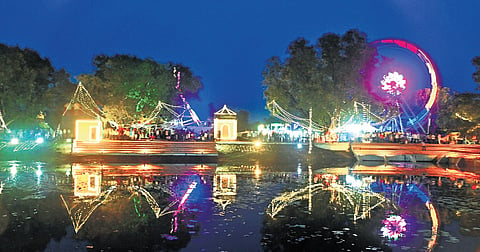
At the fair, artistes recreated the Mahabharata episode on the banks of a pond that locals believe is linked to the legendary dialogue. The main attraction, however, was the debate itself. Eight finalists, including teachers, students, a civil services aspirant, a law student and a teenager studying at Oxford University, spent nearly five hours discussing gender equality, social justice, morality, freedom, truth and responsibility.
Their audience listened for hours, offering a striking contrast to an age of shrinking attention spans and instant opinions. The event demonstrated that complex questions can hold public attention when people have the opportunity to engage with them directly.
The finale capped a much wider exercise. Rather than confining the initiative to Ajgara, the district administration took debates into villages and urban neighbourhoods across Pratapgarh.
More than 1,500 preliminary debates were planned, involving over one lakh participants. By August 26 this year, the administration had identified 1,427 promising debaters from villages and towns. Successive elimination rounds narrowed the field to 36, then 16 and finally eight finalists.
The process resembled a democratic talent hunt for ideas rather than a conventional government programme, giving participants across the district an opportunity to express their views, hear opposing arguments and develop their reasoning.
Organising a cultural show, ceremonial function or tourism promotion event around the fair would have been easier and more predictable. Pandey instead encouraged debates on subjects that can provoke disagreement, including social values, gender equality, political culture and morality. Rather than avoiding difficult conversations, the administration gave them a public platform.
The initiative reflects a broader understanding of governance. Administration is not merely about delivering services, implementing welfare schemes and maintaining law and order. It also involves fostering informed citizenship, encouraging public participation and nurturing critical thinking, particularly among young people.
The discussion on women’s equality during the finale illustrated this approach. One participant argued that equality would remain incomplete without changes in attitudes within households. Another stressed a woman’s freedom to choose her own path, while a third maintained that women must organise themselves and assert their rights.
No official answer was prescribed, and no government-approved conclusion was imposed. The value lay in hearing different positions, examining their arguments and allowing disagreement to unfold. The discussion itself was the point.
Government outreach commonly takes the form of awareness campaigns, grievance hearings and public meetings. Yaksh Samvad has created space for citizens to examine ethical and social questions that have no easy answers. By drawing on the Yudhishthir-Yaksha dialogue, Pandey sought to revive the idea that questioning is itself a public good.
The initiative also shows how cultural heritage can be connected to contemporary concerns rather than treated as a static exhibit. The ancient story provided the setting, while the debates brought its questions into the present.
As the fair continued with its familiar colour, commerce and festivities, the debate arena offered a different attraction: a space where ideas took centre stage and citizens listened to competing arguments.
For Pratapgarh, the experiment has offered a way to deepen civic engagement. For public administration, it has demonstrated how district leadership can use cultural traditions to encourage participation beyond routine governance.
Pandey indicated plans to expand the programme into an inter-district event and eventually take it to a national platform. Whether those plans materialise remains to be seen. The initiative has, however, created an opportunity for people to question, debate and listen to one another.
In an age dominated by noise, outrage and instant opinions, that space for public conversation may be among the most valuable contributions an administration can make.
