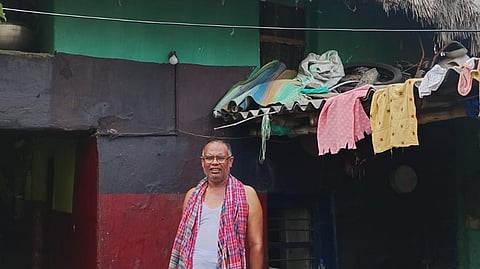

WEST BENGAL : Toran Sheikh, a 50-year-old road worker from Khalipur village in West Bengal’s Purba Bardhaman, has donated blood 105 times since 1998, even as he struggles to support his family on daily wages.
His work takes him across Purba Bardhaman, Paschim Bardhaman and parts of Murshidabad, where he repairs roads under contractors engaged by local administrations, braving scorching summers and bitter winters. A Class IV pass-out, Sheikh earns around `700-800 a day to support his wife, two daughters and son. They live in a mud house with a straw roof. Road repair work stops for about three months during the monsoon, beginning in July. To make ends meet, he also supplies labourers to contractors in Khalipur and Bamundi. He began volunteering for blood donation in 1998, when he donated blood to a worker who lost a large amount of blood in a road accident.
“There is no justification to verify the identity of a distressed person in term of religion, cast and creed. No difference in colour and religion should be taken into account when someone cries for blood. In 1998, I realised for the first time how a single drop of blood can save a life. Donating blood for an accident victim, who used to work with me, was an eye opener for me and since then I got involved with voluntary blood donation movement,” he said.
Despite his financial difficulties, Sheikh formed the Katwa Sub-division Voluntary Blood Donation Forum to organise camps in remote villages and encourage residents to donate blood. “It becomes difficult to run my family during monsoon when road repairs are not usually done but the poverty could never prevent me from organising awareness on voluntary blood donation movements and camps throughout the year.

Despite my family’s financial hardship, I formed the Katwa Sub-division Voluntary Blood Donation Forum. We organise blood donation camps in remote villages and motivate villagers to come forward for such a great humanitarian service for people,” Toran said.
He also reaches out to working-class people in tribal-dominated villages of Bardhaman, particularly during the sweltering summer, to explain the importance of blood donation. “I also reach out to the working-class people in the tribal-dominated villages in Bardhaman district and make them aware of the necessity of blood donation programmes particularly in dry season of summer when south Bengal reels sweltering heat. I never want to see someone die without getting blood,” he said.
His business card carries the appeal, “Swechhaay rakto dan karun/manuser mangal korun (donate blood voluntarily/ do good to people),” alongside lines from Rabindranath Tagore’s poem: “Bhalo mando jahai aasuk sottyere lao sahoje (Tell your mind today: Whatever good or bad may come, accept the truth with ease).”
Every year, on World Blood Donor Day on June 14, state government blood banks invite Sheikh to speak about voluntary blood donation. This year, he attended a programme at the Government Institute of Blood Transfusion Medicine & Immuno Haematology, popularly known as the Central Blood Bank. He brought tribal residents from Ambal village in the Ketugram II block of Purba Bardhaman district, all of whom donated blood voluntarily at the camp.
On October 1, Health Minister Dr Saradwat Mukherjee felicitated Sheikh at Swasthya Bhaban, the state health department headquarters in Salt Lake, for his repeated donations and efforts to spread awareness among marginalised communities in remote districts. “I can never imagine in my life that the government can give me such an honour for donating blood. I never expected anything in return. But I am very happy for the felicitation,” he said.
Dr Sunetra Majumder, deputy chief medical officer of health in Purba Bardhaman, who oversees voluntary blood donation programmes in the district, said, “Toran Sheikh’s initiatives is a genuine example for inspiration to all of us particularly at a time when a large section of sensible people is indifferent on the necessity of blood donation programmes. Despite the financial adversity in his family, he has been serving society and saving lives for years by giving blood and reaching out to people to make them aware of the blood donation movement.”