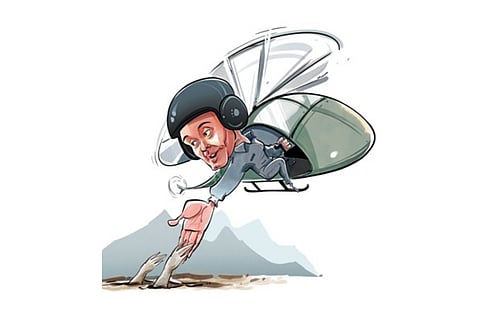

In the aftermath of Nepal’s devastating floods and landslides, rescue workers have been forced to venture into places where roads have disappeared, bridges have been swept away and entire communities have been cut off. Among them are several unsung heroes, like people whose quick decisions have saved lives when there was little time to think.
In Nuwakot, Rajendra Dawadi, principal of Tribhuvan Trishuli Secondary School, helped save around 900 students by evacuating them within minutes as floodwaters came rushing in.
But among the many encountered during the relief and rescue effort, Captain Priya Adhikari stands out for another reason. She keeps flying into the disaster.
Nepal’s first woman helicopter captain, Adhikari has flown about 100 rescue missions in just six days, taking her into some of the most difficult terrain along the Nepal-Tibet border.
In places such as Timure in Rasuwa district, the destruction left communities isolated and rescue teams with few options. Roads and bridges had been destroyed, while unstable slopes, landslides, debris and unpredictable weather made ground access extremely difficult.
The helicopter became the lifeline. For Adhikari, flying into such conditions is not new. Her career has been built around some of the most demanding forms of aviation in Nepal, high-altitude flying and search-and-rescue operations in the Himalayas.
Her journey to the cockpit began almost by accident.
She was studying for a degree in environmental science and working as cabin crew with a domestic airline when friends casually asked her to join a helicopter crew on a regular flight. It was a cold winter morning. She stepped into the helicopter not knowing that the experience would change the direction of her life.
As the aircraft lifted off, so did her ambitions. With the support of her parents, Adhikari travelled to the Philippines about 11 years ago to undergo flight training. She returned to Nepal determined to make aviation her profession and eventually became a full-time helicopter pilot in 2017.
The road was not easy. Helicopter flying in Nepal comes with risks that are amplified by the country’s extreme terrain. Pilots have to contend with narrow valleys, rapidly changing weather and limited landing areas. Search-and-rescue missions add another layer of pressure because the objective is not just to fly safely, but to reach people whose lives may depend on every passing minute.
Adhikari has seen that risk first-hand. Some of her colleagues have lost their lives in aviation accidents. Yet, she continued flying.
Over the years, she has participated in missions to rescue injured mountaineers in the Himalayas, including operations around Mount Everest. Some missions have taken her to altitudes of about 6,200 metres, heights at which helicopter operations become particularly demanding.
She was also involved in rescue efforts following Nepal’s devastating earthquake. But the latest floods presented a different challenge.
The scale of destruction meant that helicopters were being used simultaneously across isolated areas. At various points, as many as 20 helicopters were reportedly operating within narrow valleys.
Adhikari’s missions were not limited to evacuating survivors. Crews also had to reach locations where people had died and retrieve bodies from areas that could no longer be accessed by road.
For passengers, the sight of a woman in command of a rescue helicopter can still produce mixed reactions from admiration and awe to hesitation. But in the cockpit, the mountains do not distinguish between male and female pilots.
The aircraft has to be flown. The weather has to be read. The landing has to be judged. And the decision has to be made.
Adhikari’s career has unfolded against a profession still overwhelmingly associated with men. Becoming Nepal’s first woman helicopter captain has therefore been both a personal achievement and a quiet challenge to that convention.
The Covid-19 pandemic briefly brought her flying career to a halt. She remembers that period differently: it gave her the opportunity to spend time with her parents.
But once flights resumed, so did the work. Today, as Nepal confronts another major disaster, Adhikari is once again in the air.
