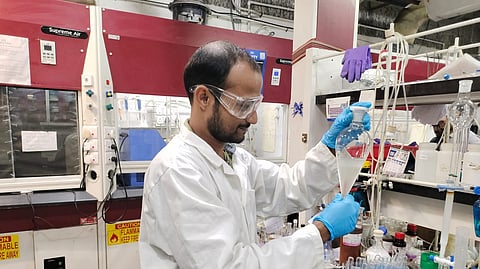

WEST BENGAL : For 30-year-old Netai Aditya, the journey from a remote village in West Bengal’s Paschim Medinipur district to a PhD in organic synthesis and catalysis has meant negotiating financial hardship at almost every stage of his education. Born into a poor family in Tentulmuri, close to Kharagpur railway station, Netai now has his eyes set on a post-doctoral position at a good university in Europe or the US. His research has been published in the Journal of the American Chemical Society.
Tentulmuri, in the Kharagpur Gramin area, has around 800 residents. About 40 per cent belong to the SC/ST communities, 40 per cent to the minority community and the remaining 20 per cent to the general category. The village, located around 140 km from Kolkata and about 15 km from the IIT-Kharagpur campus, has two state government-aided educational institutions — Tentulmuri Prathamik Vidyalaya and Tentulmuri Ramkrishna Sikshma Niketan, a higher secondary school with 600 students.
Most students come from poor families dependent on agriculture, small poultry farms and 100-day jobs under the MNREGA scheme. There is no private English-medium kindergarten in the village or its immediate vicinity.
For families struggling to meet everyday expenses, higher education has often remained a distant prospect. Netai’s own education was shaped by those constraints.
“I came from a very poor family in Tentulmuri village. My parents work hard and run our family with the income they earn as daily-wage workers under the MNREGA’s 100-day job scheme. We also have a small plot of land where we harvest seasonal crops.
But the income is not adequate to run a family of five apart from meeting our education expenses,” Netai said. His father admitted him to Tentulmuri Prathamik Vidyalaya education. But Netai later moved to another school in Keshpur, around 10 km from his village. He stayed at his maternal uncle’s house there and continued his studies until Class X.
He passed Higher Secondary with 85 per cent marks in 2014 from Paramanandapur Jagannath Institution in Balaipanda and joined Midnapore College for BSc (Honours) in Chemistry. But paying for his undergraduate education was difficult. “I couldn’t afford a private tutor’s help for Chemistry Honours.
Sometimes the financial crisis was so bad that I used to come back home during vacations and work under the MNREGA scheme as a substitute for either my mother or father when they could not go for their daily-wage work because of illness,” he said. He managed to attend private tuition for a few months, particularly before exams, using the money he earned from the 100-day job scheme.
After completing his graduation with honours, Netai appeared for the all-India IIT Joint Admission Test for an MSc in Chemistry and secured 25th rank. In 2017, he joined the MSc course at IIT-Mumbai and completed it in 2019. But his financial difficulties followed him there too. Tuition, hostel, food and other expenses required around `60,000 a year, an amount his family found difficult to arrange. He completed his PhD at the Indian Institute of Science Education and Research (IISER), Kalyani.
During his doctoral research, Netai developed a methodology for manufacturing pharmaceuticals and agrochemicals that can be used for new drugs. He now wants to pursue post-doctoral research at a leading university in Europe or the US.
