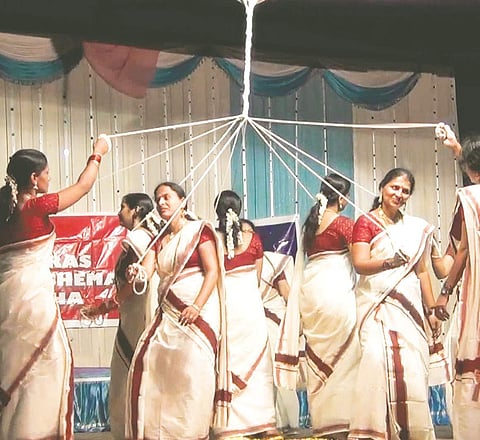

Many know Thiruvathirakali as a beautiful dance form, with its fine blend of song and dance. This dance, which is popular in Kerala, has been practiced by the women of the state for decades in their belief that they will attain everlasting marital bliss. But here comes the twist! Thiruvathirakali has now evolved into a game called Pinnal Thiruvanthira — a competitive game for some, a leisure timepass for many others.
Pioneered by Thiruvathira exponent Maladhi G Menon, this dance-game is gaining popularity among men and women in the state. “The idea was inspired by a traditional Tamil Nadu folk dance called Pinnal Kolattom. The dance is very beautiful and it made use of a lot of ropes,” she says.
“There was a lot of rhythm involved and I thought it would be an excellent contribution and customisation to Thiruvathirakali. A lot of energy is involved, so it can only be played for fifteen minutes — after which, sometimes the coordination goes kaput! Instead of clapping, as is done in Thiruvathirakali, we make use of the ropes in the hybrid game of Pinnal Thiruvathira,” she added.The success of the dance-game lies in the rhythm that finally brings out an intricately woven ribbon dangling from a round board.
Years of research: Malathi researched the possible scope and eventual acceptability of such a twist to traditional Thiruvathira for close to ten years. Only when she was sure that the game would succeed, did she decide to introduce Pinnal Thiruvathira to the world. Finally, in 2013, at a public space in Kochi, Malathi choreographed 300-odd women who had assembled at a function in Kochi and showcased this game to the world. Soon after, Malathi assembled over 3,000 women and went on to create a Record in the Limca Book of Records in 2014. Sanil P Thomas, an author and sports editor shares that the Pinnal Thiruvathira is currently considered a competitive game.
How the game is played:
Ten dancers are given one rope each. The ropes are hung on a large-size rolling pin board. The dancers move in and out swiftly in a criss-cross manner. The ropes are used by all the dancers and are entwined into a plait while each song is played. With the start of a new song, the plaited ropes have to be dismantled gracefully and back to its original position. “Though the game starts at a slow pace akin to Thiruvathira, the movement gains momentum towards the end of the song,” adds Malathi.