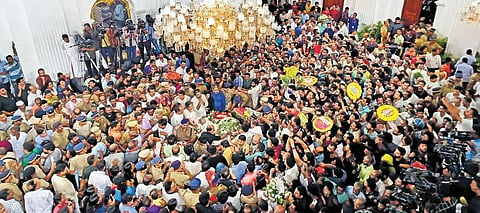

THIRUVANANTHAPURAM: Thiruvananthapuram was Oommen Chandy’s second home. Although Puthuppally in Kottayam was in his blood, the capital city was close to his heart. In his long-spanning political career and personal life, ‘Puthuppally House’ in Jagathy played a major role. Even now, he had only an ancestral house at Puthuppally. In his first tenure as the chief minister of Kerala, he chose to live at this house at Jagathy even though he was offered to reside at Cliff House, the official residence of the chief minister. He happily refused the offer and asked the then Speaker, Vakkom Purushothaman, to stay there.
Early days in the capital
Chandy started living in Thiruvananthapuram in the 1970s when he became an MLA. After his marriage, he and his wife, Mariamma Oommen, relocated to Thiruvananthapuram and stayed in a rented house at Vazhuthacaud, near the All India Radio office. He was more than a politician when he slowly started a social connection with the people in the capital city. He later shifted to a rented house at Jagathy, near where he bought land and built the Puthuppally House.
M M Hassan, the UDF Convenor and Thiruvananthapuram native, reminisces about Chandy’s connection with the capital city. “Since the mid-1970s, Chandy’s political and personal life has been in Thiruvananthapuram. When he shifted to Jagathy, I was his neighbour. His wife was an employee of Canara Bank here, and his son and daughters went to Carmel School. Even though he is a native of Kottayam, his love for Thiruvananthapuram is unmatched. His contributions to the development of Thiruvananthapuram are also many,” he told TNIE.
Infrastructure development of capital
Chandy also left an indelible mark on the infrastructure development of Thiruvananthapuram. It was during his second tenure as the chief minister that major projects like Vizhinjam Port, Greenfield International Stadium, hosting National Games, Operation Anantha, and the widening of NH 66 broke ground.
Though there was stiff opposition from the senior Congress leaders to give the Vizhinjam project to the Adani Group, it was Oommen Chandy’s confidence that led to the groundbreaking of the project in 2015. In fact, it is a dream come true for many people in Thiruvananthapuram. It was through his efforts that the capital city hosted the National Games in 2015. As part of it, he had proposed the Greenfield Stadium at Kariavattom on Kerala University’s land, and the then Sports Minister K B Ganesh Kumar fully supported it.
The next path-breaking infrastructure project was Operation Anantha, which is the cleaning of waste-clogged canals in the city to avoid water logging at Thampanoor and East Fort. When the then chief secretary and then district collector Biju Prabhakar had a proposal with the name Operation Anantha, Chandy extended full support for them to implement it on a war footing. Since the first phase of the implementation of Operation Anantha, the city has witnessed less flooding.
During this period, the construction of the Kazhakootam-Mukkola NH 66 started. The state government then gave full support to the National Highways Authority of India so as to ensure the completion of the highway in the stipulated time frame. This stretch later became a hotbed of investment and turned out to be a happening corridor. The first phase of the Karamana-Kaliyikkavila road development project, starting from Karamana to Pravachambalam, also took place during his tenure. Despite the hurdles in the land acquisition of the project, his government succeeded in the first phase of development.
The approval of the first private IT co-developer Taurus Investment Holdings at Technopark Phase-III also took place during his tenure. He welcomed such investments and inaugurated the project before he stepped down as CM in 2016.
Jiji Thomson, former chief secretary and advisor to Oommen Chandy, said that the NH 66 project from Kazhakootam to Mukkola was realised due to his willpower alone. “When the development of the road took place, we had a challenge to cut down the trees. At that time, many environmentalists, including the late poet Sugathakumari, opposed it. But the CM advised me to hold talks with Sugathakuamri.
Thus, I put forth the suggestion of identifying land near Sainik School to plant trees. She agreed, and the government allocated funds for it. Similarly, when I presented a video on the floods in Thiruvananthapuram, he told me to resolve the issue at the earliest. He also insisted that I lead the team for the flood mitigation programme. Later, the ambitious programme of the capital, Vizhinjam Port, was also materialised due to his decision, even though there was opposition,” he said.
Jiji also said that Chandy always had a bond with Thiruvananthapuram. He goes to Puthuppally only on Sundays and soon returns to Thiruvananthapuram. “He is truly a Thiruvananthapuram native,” Thomson said. According to V S Sivakumar, a former colleague of Oommen Chandy and a native of Thiruvananthapuram, a 42-kilometre network of roads in Thiruvananthapuram was developed to international standards during his tenure. “I was the health Minister then when Oommen Chandy was CM in the second tenure. At that time, Chandy proposed to convert the General hospital in Thiruvananthapuram into a medical college. But it didn’t take off when the LDF government came to power in 2016,” Sivakumar said.
A gamechanger: TCCI
“All the major infrastructure projects that turned out to be game changers for the development of the capital started during his period. Be it Vizhinjam, Greenfield Stadium, Operation Anantha, IT development, or national highway development, Chandy had given back the ownership of ‘Trivandrum Gold Club’ when it was acquired by the state government during the period of V S Achuthanandan. Moreover, he was a people’s leader, and whenever we called him, he was reachable to us at any time,” said S N Reghuchandran Nair, president of the Trivandrum Chamber of Commerce and Industry.
