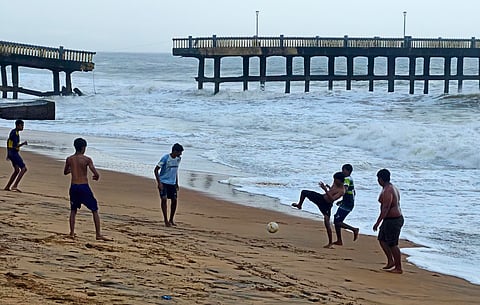

In the amber beaches of Thiruvananthapuram, for those drunk on football, Neymar is ‘Lord of the Sand’. He is a magician, who learnt the basics of dribbling on the beaches of São Vicente.
“This World Cup, we root for him and Brazil,” says a Class 12 student, Vipin Christudas, as he dribbles on the sands of Vallakkadavu.
“Neymar means hope. We often recall when the dribbler was spotted in 1998 on a beach near São Vicente. That makes us heady even now,” he says.
Before Vipin, his father and uncles grew up playing on the beaches. The connection between football and the beaches along Thiruvananthapuram, Kozhikode, and Malappuram goes back decades. Over time, local clubs emerged around coastal communities, organising tournaments that drew large crowds.
“No one noticed us then. But now, things are changing. Packed crowds are gathering to watch local tournaments, and players are even making it into professional circuits. Like Antony Raju, the coastal boy who is now with the Kombans FC (SLK team),” says Vipin.
Nowadays, these coastal villages are organising massive watch parties on the grounds. Banters during training and game sessions hover over possible winners.
Hoardings of football titans almost touch the skies, some 50ft tall, with catchy captions bringing out the zest and dominance of the players.
“We also have tournaments running in parallel. Recently, Pulluvila clubs had conducted a FIFA mini World Cup tournament and local groups in Puthiyathura are conducting one match per day,” says Rohit Yesudas, captained India in AFC Beach Football Asia Cup.
Rohit remembers growing up playing on the beach at Pallum near Poovar. “We started playing as any outdoor activity. There were no good grounds, so the beach was the only option. But now, with some of us playing professionally, the younger lot is very inspired,” he says.

Antony Raju is one such inspiration, whose story began playing on the Vizhinjam sands, idolising Kaka and Pele.
“We used to play barefoot. My first game with boots was when I was in Class 9. Now, there is a newfound energy, with local clubs organising coaching sessions. In fact, even the city-based clubs bring their teams to beaches for practice,” he says.
Along the coast, jerseys bearing the names of Lionel Messi, Cristiano Ronaldo, and Kylian Mbappé may be a common sight. Yet it is Neymar who tops the chart.
“He is the King of the Streets,” says Rohit, who feels beach practice shapes Brazilian footballers towards their unique playing style. “Playing on the beach is a struggle and so is getting the ball under control, forcing players to improve technique and decision-making. Maybe that’s why greats like Messi train on beaches,” he remarks.
Ronaldinho is another favourite. “He could do things with the ball that nobody ever expected,” says a young player.
The admiration extends beyond international stars. Indian football icon Sunil Chhetri is seen as proof that local footballers can also compete at a high level.
In recent years, thanks to an evolving football landscape in the state, the World Cup is no longer just a sporting spectacle and is more a reminder that football journeys can begin in unexpected places.
This story was written by Kashinath S Nayar for TNIE-Kerala