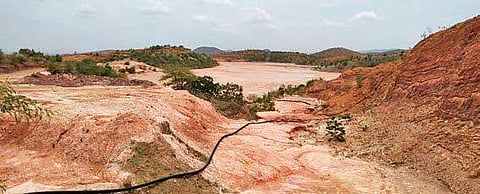

VIJAYAWADA: The Andhra Pradesh Pollution Control Board has endorsed Nagpur-based National Environmental Engineering Research Institute (NEERI) to conduct a study on the tailings pond created by the Uranium Corporation of India Ltd (UCIL) at Tummalapalle uranium mine in Kadapa district.
The institute is expected to start the field study soon to assess if the tailings pond, which the APPCB said did not follow its guidelines while creation, was the source of reported contamination of ground water in nearby areas.
“The endorsement was given to NEERI a couple of days ago to study the tailings pond, in which the remnants of the mining process are stored in the form of slurry. Once the study begins, the team will submit an interim report to ascertain if there is any contamination because of the pond. The final observations will be submitted in about 10-12 months,” a senior official from APPCB told TNIE.
The team will do a complete hydrology examination and also test and analyse the borewells present in and around the tailings pond. The reason a third-party has been engaged to study the tailings pond is because the mining agency has not followed certain guidelines issued by the APPCB.
Sources said that the Pollution Control Board, while issuing the consent for establishment (CFE) and consent for operation (CFO), told the UCIL to create a three-layered pond for dumping the semi-solid slurry that contains other minerals. However, the officials said that the guidelines were not followed. “We told them to have a compact layer of black cotton soil with higher permeability coefficient along with polythene layering. Then it will be topped with another layer of soil. The three-layered arrangement will be impervious. But, the agency has not done so,” the official explained.
The agency, on its part, is said to have informed the APPCB that it has been following the standard guidelines of Atomic Energy Regulatory Body (AERB). It may be recalled that locals and activists have been alleging groundwater contamination due to uranium mining.
The mining agency has stated in the past that detailed scientific studies showed no significant anomaly in the quality of groundwater collected from monitoring wells constructed around the tailing ponds in line with the international practices. It also denied the allegations of contamination because of tailings pond as there was no scientific evidence to establish the same.
“They also said that they have been following the same process that is being implemented in other uranium mines in other States, and are confident that there is no scope for permeability of slurry for possible contamination. But, as they didn’t follow our guidelines, we wanted to conduct a study to clear the apprehensions. That is why we endorsed the job to a third party,” the senior APPCB official elaborated.