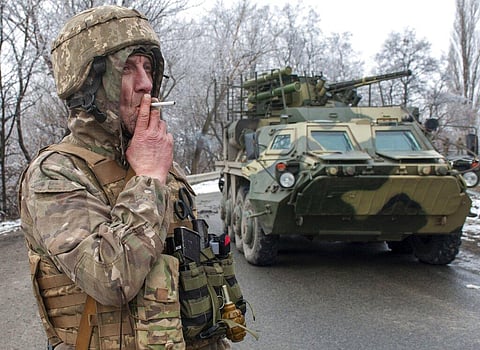

KYIV: The office of Ukraine’s president has confirmed that a delegation will meet with Russian officials as Moscow’s troops draw closer to Kyiv.
Ukrainian President Volodymyr Zelenskyy office said Sunday on the Telegram messaging app that the two sides would meet at an unspecified location on the Belarusian border and did not give a precise time for the meeting.
The meeting news came shortly after President Vladimir Putin ordered Russian nuclear forces put on high alert in response to what he called “aggressive statements” by leading NATO powers.
From Moscow to Siberia, Russian anti-war activists took to the streets again Sunday to protest Russia’s invasion of Ukraine, despite the arrests of hundreds of protesters each day by police.
Demonstrators held pickets and marched in city centers, chanting “No to war!” as President Vladimir Putin ordered Russian nuclear deterrent to be put on high alert, upping the ante in the Kremlin’s standoff with the West and stoking fears of a nuclear war.
“I have two sons and I don’t want to give them to that bloody monster. War is a tragedy for all of us,” 48-year-old Dmitry Maltsev, who joined the rally in St. Petersburg, told The Associated Press.
Protests against the invasion started Thursday in Russia and have continued daily ever since, even as Russian police have moved swiftly to crack down on the rallies and detain protesters. The Kremlin has sought to downplay the protests, insisting that a much broader share of Russians support the assault on Ukraine.
In St. Petersburg, where several hundred gathered in the city center, police in full riot gear were grabbing one protester after another and dragging some into police vans, even though the demonstration was peaceful. Footage from Moscow showed police throwing several female protesters on the ground before dragging them away.
According to the OVD-Info rights group that tracks political arrests, by Sunday evening police detained at least 1,474 Russians in 45 cities over anti-war demonstrations that day.
Four days into the the fighting that has killed scores, Putin raised the stakes dramatically on Sunday, ordering the military Russia’s nuclear forces on high alert, citing Western countries “taking unfriendly actions against our country in the economic sphere” and "top officials from leading NATO members made aggressive statements regarding our country."
The day before, the U.S. and its European allies have warned that the coming round of sanctions could include freezing hard currency reserves of Russia’s Central Bank and cutting Russia off SWIFT international payment system. The unprecedented move could quickly plunge the Russian economy into chaos.
Ordinary Russians fear that stiff sanctions will deliver a crippling blow to the country's economy. Since Thursday, Russians have been flocking to banks and ATMs to withdraw cash, creating long lines and reporting on social media about ATM machines running out of bills.
According to Russia’s Central Bank, on Thursday alone Russians withdrew 111 billion rubles (about $1.3 billion) in cash.
The anti-war protests on Sunday appeared smaller and more scattered than the ones that took place on the first day of Russia’s attack in Ukraine, when thousands of people rallied in Moscow and St. Petersburg, but their true scale was hard to assess and they seemed to pick up speed as the day went on.
“It is a crime both against Ukraine and Russia. I think it is killing both Ukraine and Russia. I am outraged, I haven’t slept for three nights, and I think we must now declare very loudly that we don’t want to be killed and don’t want Ukraine to be killed,” said Olga Mikheeva, who protested in the Siberian city of Irkutsk.
Approximately 100,000 people have turned out in Berlin to protest Russia's invasion of Ukraine and show solidarity with the Ukrainian people.
Police said large crowds have filled the area originally planned for the demonstration, around the Brandenburg Gate in central Berlin, and that they were allocating additional space to accommodate the protesters.
Sunday's protest was peaceful, including many families with children.
People waved yellow and blue Ukrainian flags to show their support.
Some carried placards with slogans such as "Hands off Ukraine" and "Putin, go to therapy and leave Ukraine and the world in peace."
Beate Schmid, who works as a scientist in Berlin, said she works closely with academics in Ukraine.
"Their sons and brothers and husbands are now being drafted to fight against the Russians," she said.
"It's so sad. Simply unbelievable."