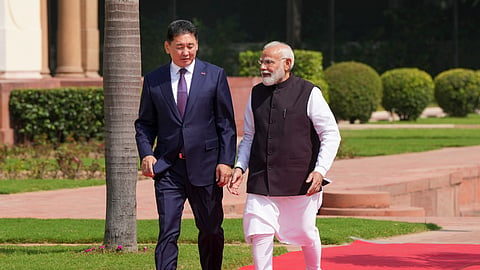

NEW DELHI: In a visit to mark 70 years of diplomatic relations and a decade of strategic partnership, Prime Minister Narendra Modi and Mongolian President Khurelsukh Ukhnaa held extensive delegation-level talks in New Delhi on Tuesday, signalling a renewed push to deepen bilateral ties across sectors—from defence and digital innovation to heritage and humanitarian aid.
The talks culminated in the exchange of multiple memorandums of understanding (MoUs), including cooperation in immigration, geology and mineral resources, humanitarian assistance, digital public infrastructure, and the restoration of heritage sites in Mongolia.
To mark the occasion, Modi and President Ukhnaa jointly released commemorative stamps celebrating the diplomatic milestone.
“Our borders may not touch, but our hearts and heritage do,” said Prime Minister Modi, announcing free e-visas for Mongolian citizens and new people-to-people initiatives. “India will also sponsor youth cultural ambassadors from Mongolia to India. We are expanding our partnership at every level,” he said at a joint press conference.
Among the key highlights was the signing of a local-level cooperation agreement between the Ladakh Autonomous Hill Development Council and Mongolia’s Arkhangai province, underlining both countries' focus on cultural and civilisational linkages.
Education and spiritual ties were front and centre, with Modi announcing a historic partnership between Nalanda University and Mongolia’s Gandan Monastery—two institutions with deep Buddhist roots. “Nalanda has made a huge contribution to Buddhism. This new partnership will energise our centuries-old civilisational ties,” he said.
A major focus of the talks was India’s flagship infrastructure project in Mongolia—a $1.7 billion oil refinery, being developed with Indian assistance under a line of credit. This is India’s largest infrastructure initiative on foreign soil, and is expected to be completed by 2028, according to Secretary (East) P. Kumaran.
President Ukhnaa called the refinery project “strategically crucial” for Mongolia’s energy security and a “flagship symbol” of bilateral ties. “This project will directly contribute to Mongolia’s economic prosperity,” he said.
On the defence and security front, PM Modi noted the “huge leap” in cooperation over the past decade. “From training to the appointment of Defence Attachés, our defence ties are expanding. We will also launch new capacity-building programmes for Mongolia’s border security forces,” he said. Secretary P Kumaran in the MEA later told the media that India and Mongolia are now looking to firm up cooperation in drones and emerging technologies, reflecting their shared security and strategic priorities.
The leaders also reaffirmed shared positions on global issues, reiterating their commitment to a free, open, and rules-based Indo-Pacific and strong collaboration at multilateral forums. “We are united in raising the voice of the Global South,” Modi said.
With renewed momentum, historic cultural ties, and a growing strategic agenda, the India-Mongolia partnership is poised for a new era of cooperation—one rooted in shared values and a common vision for regional stability and development.
