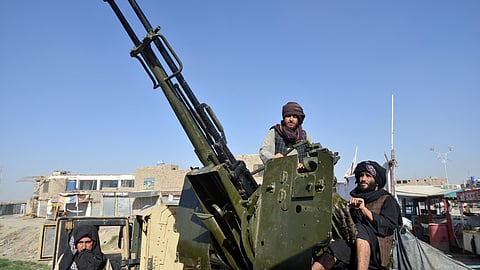

Pakistan and the Taliban-led administration in Afghanistan announced a 48-hour ceasefire on Wednesday, temporarily halting the deadliest border clashes seen in years, which left dozens of people killed and wounded on both sides. The fragile truce comes after a dangerous escalation threatened to further destabilize the volatile region.
The ceasefire was announced following appeals for restraint from major regional powers, including Saudi Arabia and Qatar, as international concern mounted over the violence.
While both nations confirmed the pause in fighting, they offered conflicting accounts of who initiated the deal. Pakistan’s Foreign Ministry stated the agreement was for 48 hours and was reached at the request of the Afghan Taliban regime.
Moments later, Taliban government chief spokesman Zabihullah Mujahid posted on social media that the truce was agreed upon at the "insistence" of the Pakistani side, notably omitting any mention of a 48-hour time frame.
Despite the agreement, key border crossings remain closed, indicating that tensions remain high.
The ceasefire announcement followed a day of intense exchanges, including reports of strikes and civilian casualties.
In the Afghan capital, Kabul, explosions were reported, and the humanitarian group Emergency NGO confirmed its surgical center received five dead and 40 wounded.
Dejan Panic, the NGO’s country director, said victims suffered "shrapnel wounds, blunt force trauma and burns," with 10 remaining in critical condition. The cause of the Kabul blasts was unclear.
While the Taliban confirmed an oil tanker explosion, two anonymous Pakistani security officials claimed their military had conducted precision strikes against militant hideouts in the capital.
Earlier in the day, Pakistan claimed its troops killed dozens of Afghan security forces and militants during overnight fighting.
Taliban spokesman Mujahid accused Pakistani forces of using light and heavy weapons in assaults on Spin Boldak in southern Kandahar province, claiming over a dozen people were killed and more than 100 wounded, including civilians. He said Afghan forces returned fire, killing several Pakistani soldiers.
Pakistan denies targeting civilians, maintaining that its forces were repelling "unprovoked" assaults.
Meanwhile, residents in the Pakistani border town of Chaman reported that mortars were falling near villages, prompting people like Najibullah Khan to warn that families were "leaving the area" out of fear.
The recent clashes are rooted in deep-seated security issues and mutual accusations across the Durand Line, the long, contested border.
Pakistan accuses the Afghan Taliban of harboring armed groups, particularly the Tehreek-i-Taliban Pakistan (TTP), who are responsible for a sharp increase in militant attacks inside Pakistan since the Taliban seized power in Kabul in 2021.
The Taliban rulers categorically reject this charge, insisting that Afghan territory is not being used to attack its neighbor.
Defense analyst Abdullah Khan noted that the border regions have been prone to chaos since 1979. He pointed out that following the 9/11 attacks, the area became a haven where groups like the Afghan Taliban and al-Qaida operated from both sides to attack NATO and Pakistani security forces.
The current fighting, therefore, highlights the ongoing struggle to stabilize a region where extremist groups are attempting to resurface.
(Wth inputs from AP, AFP)
