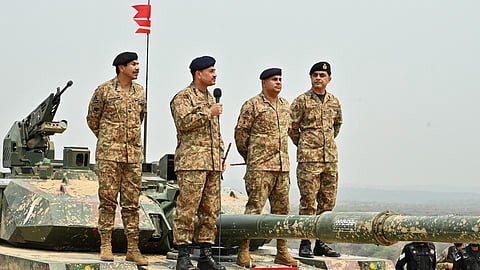

NEW DELHI: Pakistan is moving to raise a standalone UAV Corps within its Army, intelligence sources told The New Indian Express, in a structural push to institutionalise drone warfare capabilities as unmanned systems redefine the character of contemporary conflict.
Sources said that an “Army Unit Pocket for Excellence” has already been set up, likely as an incubatory formation for the proposed Corps-level structure.
“They’re essentially testbeds for evolving UAV tactics and procedures, while also doubling up as a training hub for operators,” sources said. “At the same time, they serve as a bridge with external suppliers, largely Chinese and Turkish platforms in Pakistan’s case. Such units are typically precursors to larger formations, with concepts stabilised here before being scaled up.”
Pakistan’s move also comes against the backdrop of a changing internal threat profile. Groups such as the Tehreek-e-Taliban Pakistan (TTP) and the Ittehad-ul-Mujahideen Pakistan (IMP) are increasingly deploying commercially available quadcopter drones for offensive operations, pointing to a shift from traditional tactics like IEDs and suicide bombings to low-cost aerial attacks.
“The use of commercial quadcopters has changed the threat profile. These are harder to detect and neutralise at the tactical level,” another source said, adding that the shift has contributed to higher casualties among security personnel.
Incidentally, last week, the Pakistan Army was also compelled to activate a specialised counter-drone unit after a spate of increasingly sophisticated aerial incursions by militant groups, including threats to critical oil infrastructure, amid the ongoing West Asia conflict.
Moreover, such “pockets of excellence” are not without precedent. The United States, for instance, has long relied on dedicated centres of excellence to develop UAV tactics, training and integration frameworks before wider force adoption.
In contrast, the Indian Army has adopted a more distributed approach, embedding unmanned systems across combat arms rather than moving towards a standalone structure.
Earlier this week, the Army unveiled a nearly 50-page “technology roadmap” for unmanned aerial systems (UAS) and loitering munitions, outlining detailed technical and operational requirements in line with the evolving character of warfare. The document, meant for industry and academia, identifies 30 types of UAS and loitering munitions across five categories, translating into around 80 variants.
Learning from recent conflicts, including Operation Sindoor, the Army has moved beyond standalone UAV units to integrate such capabilities into frontline formations. While the Army Aviation Corps (AAC) continues to handle long-range UAV operations, drones are increasingly being embedded at the tactical level.
In the Armoured Corps, work is underway to raise ‘Shaurya’ squadrons to integrate UAV-led surveillance and precision strike capabilities into mechanised operations, with at least one squadron planned for each of the six operational commands in the initial phase, followed by gradual expansion across all 63 armoured regiments.
The broader institutionalisation of unmanned systems is also extending to other arms. In the infantry, ‘Ashni’ platoons raised last year are equipped with surveillance UAVs and loitering munitions for tactical ISR and strike roles.
Meanwhile, in the artillery, ‘Divyastra’ batteries, raised under a ‘save and raise’ model, have integrated UAV-based targeting with conventional gun systems to compress engagement timelines. In addition, dedicated ‘Shaktibaan’ regiments have been raised for long-range precision strikes using swarm drones, remotely piloted aircraft systems (RPAS) and loitering munitions.
