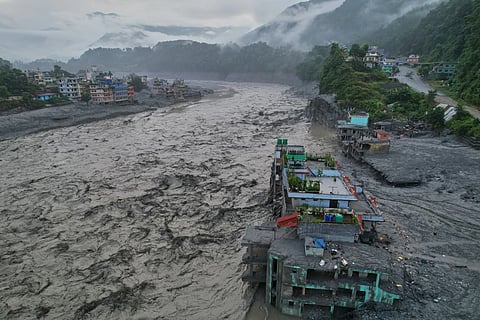

Over the past four days, Nepal’s Press Council, the country’s media regulatory body, has instructed 72 social media users to remove inappropriate content, most of it posted through personal accounts, as the country reportedly battles a flood of misinformation in the aftermath of the recent floods, The Kathmandu Post reports.
The scale and speed of the misinformation have complicated an already chaotic information environment at a time when families are desperately searching for missing relatives and authorities are struggling to establish the full extent of the disaster, the report said.
For social media users chasing views and virality, the floods have also become a source of lucrative content.
For instance, according to the report, at 7:26 am on Saturday, a Facebook page called Dudhauli FM posted a 20-second video claiming to show Home Minister Sudan Gurung inside a tunnel at the disaster site.
“Home Minister Gurung’s unique style: He reaches inside the tunnel at the incident site to join the rescue,” the caption said, praising what it described as the minister’s proactive involvement.
The page later amended the caption.
The video quickly spread across Facebook, TikTok and X.
But it was not from Nepal.
Fact-checkers established that the footage showed a tunnel rescue operation in Uttarakhand, India. The uniforms worn by the rescuers and the surroundings matched those seen in the original footage, which had been posted on the Fire Service Uttarakhand Police’s Facebook page on August 14.
Meanwhile, the Press Council has opened a dedicated portal titled “Special Complaints on the Bhotekoshi Incident”, through which members of the public can report misinformation and graphic material.
By 5 pm on Saturday, the portal had received 101 complaints, according to Umesh Shrestha, chairman of the Press Council.
Chetana Kunwar, assistant editor at Nepal Fact Check, reportedly said misleading visuals connected to the Bhotekoshi flood were increasingly being created using AI.
“AI-generated content and manipulated ‘before and after’ visuals make it significantly easier to create false impressions, which can be extremely difficult for the general public to detect,” she said. “At the same time, videos from disasters in other countries are deliberately being circulated as if they were from Nepal.”
