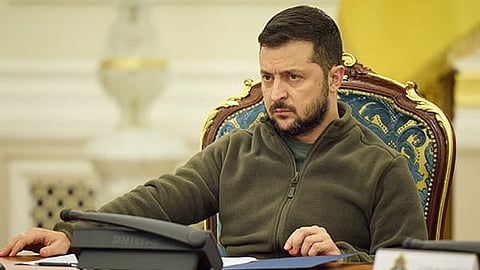

KYIV: Just when Ukraine appeared to be gaining momentum on the battlefield, President Volodymyr Zelensky ordered a surprise government reshuffle that included the dismissal of his defence minister, triggering rare protests across the country.
Parliament has approved a new prime minister -- former head of the state gas operator Naftogaz, Sergiy Koretsky -- and most of his team.
But the appointment has been overshadowed by opposition to the removal of the popular Mykhailo Fedorov as defence minister, and his blistering attack on the army's top commander.
Why now?
The shake-up comes less than a year since the last reshuffle and only six months after Fedorov was appointed with a remit to reform the military.
It also happens at a moment of relative optimism for Kyiv in the war, with Ukrainian troops having stalled Russian momentum and intensified strikes on Russia's territory.
Zelensky has given little explanation, saying only that "it is important to prepare the country for winter" -- a task he entrusted to Koretsky.
Opposition lawmaker Inna Sovsun told AFP the move "came out absolutely unexpected".
Intrigue has surrounded the timing.
Political expert Volodymyr Fesenko said the reshuffle was likely linked to Zelensky's desire to appoint former prime minister Yulia Svyrydenko as US ambassador, after Ukrainian media reported the current envoy was facing a corruption probe.
Koretsky is being tasked with preparing Ukraine and the energy sector for winter, when Russia is set to resume attacks that have crippled the power grid and left millions without heating or electricity in subzero temperatures.
Defence split
The ousting of Fedorov has divided the country and military establishment, triggering street protests and unusually direct political statements from senior military figures.
Fedorov said his removal was triggered by army chief Oleksandr Syrsky, who he alleged had presented Zelensky with an ultimatum.
"A president in wartime should not have to choose in such a situation, honestly," Zelensky said, saying the two sides were barely on speaking terms.
"I would very much like unity," he added.
Appointed in January, Fedorov pushed modernisation of the army, which led him to clash with the more traditional Syrsky.
"We need to focus on the war and on an effective strategy," Syrsky said.
A deputy air force commander resigned in protest, saying Fedorov's removal would "do great evil to the country's defence".
Ukraine's Joint Forces Commander Mykhailo Drapaty, a rumoured possible successor to Syrsky, said the army "needs change" and must not halt the reforms.
Zelensky has appointed Yevgeniy Khmara, a career intelligence official with a low political profile, as acting defence minister.
Under-fire top commander
Central to the row are Fedorov's allegations that Syrsky was a block on much-needed reforms to a military worn down by four years of war and hit by scandals over the treatment of conscripts.
Syrsky was born in Soviet Russia in 1965 and stayed in Ukraine when the Soviet Union collapsed.
His reputation as an effective commander was burnished in the first months of the war, leading the defence of Kyiv after Russia's invasion and successfully halting attempts to seize the capital.
He also commanded Ukraine's lightning autumn 2022 counter-offensive in the northeastern Kharkiv region which recaptured swathes of territory.
But he has faced criticism for resembling Soviet-style generals and not caring about human losses, in contrast to Fedorov, who favoured a war of drones designed to spare lives.
Analysts said Zelensky ultimately chose not to change his top commander at a crucial moment, opting instead to remove Fedorov, his long-time aide and supporter.
What next?
Though Zelensky has appointed an acting defence minister, the formal appointment needs approval by parliament.
No session to vote on the replacement has yet been scheduled.
Fresh protests calling to reinstate Fedorov are planned for Friday evening in various Ukrainian cities.
War impact
Russian military bloggers rejoiced over the chaos, with one thanking Zelensky for removing a minister who "caused so many problems" for Moscow's troops.
Drone pioneer Maria Berlinska said the country had lost a "mega-competent minister" who would have "managed to turn the tide".
"We won't feel the consequences tomorrow... but by late autumn, and definitely winter, we will feel them," she added.
A Ukrainian soldier serving on the front line told AFP they were baffled by the decision.
"Unfortunately, political decisions directly determine how we fight, what we fight with, and how many people will return from this war alive."
