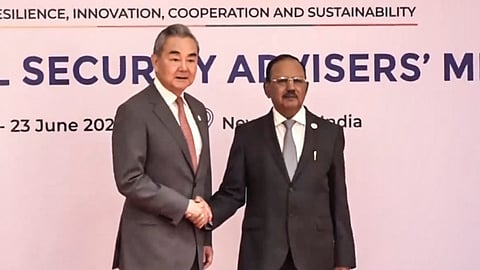

NEW DELHI: Chinese Foreign Minister Wang Yi has said it is “imperative” for India and China to respect each other’s “core interests” and take concrete steps to implement the consensus reached by the leaders of the two countries, as the neighbours continue efforts to stabilise ties after years of border tensions.
Wang made the remarks during talks with National Security Adviser Ajit Doval in New Delhi on Monday, on the sidelines of the BRICS National Security Advisers’ meeting, according to China’s state-run Xinhua news agency.
The two leaders, who also serve as Special Representatives on the India-China boundary question, reviewed bilateral relations and discussed progress in the ongoing normalisation process.
“India is an important neighbour of China, and bilateral relations have returned to the path of recovery and improvement,” Wang said, according to an official Chinese readout of the meeting.
Highlighting the significance of recent engagements between the two countries’ leaders, Wang said, “The leaders of the two countries agreed that China and India are partners rather than rivals, thus establishing the most important strategic consensus between the two sides and providing an important impetus and strategic guarantee for the healthy and stable development of China-India relations.”
Calling for greater cooperation between the two Asian powers, Wang said China and India should view their ties from both a long-term and a global perspective.
“As the world’s two most populous countries, China and India should not only view bilateral relations from a long-term perspective but also promote cooperation from a global perspective,” he said.
Wang further stressed that both sides should work to implement the understandings reached by their leaders and advance cooperation to support development and the aspirations of the Global South.
“It is imperative to respect each other’s core interests, properly handle sensitive issues, and place the China-India border issue in an appropriate position so that it does not affect the overall trajectory of bilateral relations,” he said.
