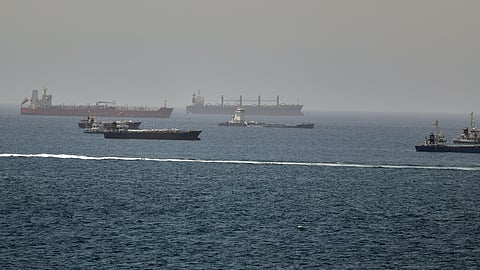

LONDON: Traffic through the Strait of Hormuz continued to improve compared to pre-US and Iran agreement levels on Tuesday, with some ships crossing through a new IMO evacuation route, tracking data showed.
As of 1500 GMT on Wednesday, maritime tracking firm Kpler recorded 25 transits by commodity ships on Tuesday, and 17 so far on Wednesday.
Total figures are likely to rise further, as crossings are identified retrospectively, notably through satellite imagery.
Tuesday's crossings fall short of the 38 commodities transits detected on Monday, the highest amount since the Strait of Hormuz was closed down by Iran on March 1 at the start of the Middle East war.
However, Tuesday's crossings continue to suggest an improvement in traffic compared with figures before the US and Iran agreed to a memorandum of understanding on June 14.
Since June 15, on average 22 ships have crossed every day according to Kpler, compared with less than 10 daily transits between March 1 and June 14.
In peacetime, around 120 ships normally pass through the Strait of Hormuz each day, carrying about a fifth of global oil and LNG gas exports, making it one of the world's most important waterways.
Marine Traffic, a Kpler-owned website, showed multiple vessels passing through new International Maritime Organisation (IMO)-approved routes, which the UN body announced on Tuesday to help evacuate the 11,000 seafarers still stuck in the Gulf.
These routes include a passage hugging the Omani shore for ships exiting the Gulf, and a route in Iranian waters for traffic going in both directions.
IMO chief Arsenio Dominguez told AFP on Wednesday that the UN agency hopes to soon see around 50 vessels evacuated through these routes each day.
Very large crude carriers (VLCC), supertankers capable of carrying over around 2 million barrels of oil, have been crossing the strait more since the US-Iran agreement.
Three VLCCs -- including an empty one -- crossed on Wednesday, collectively exporting 4.1 million barrels of crude oil out of the Gulf, according to Kpler data.
On Tuesday, five VLCCs crossed the strait, three of them laden.
At least four Iran-linked commodities vessels have crossed since Tuesday.
The US said on Monday it was temporarily lifting sanctions on Iran to let it produce, sell and deliver crude oil and related products through August 21.
Iranian-linked traffic through the strait had dropped significantly as a result of a US blockade of Iranian ports enforced since April 13, which Trump said on Tuesday the US was no longer enforcing.
