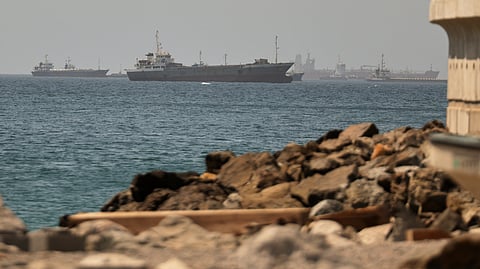

TEHRAN: Iran said Monday it had held its first meeting with Oman on managing the Strait of Hormuz since it signed a preliminary deal to end the West Asia war with the United States.
The announcement followed the US saying it had agreed with Iran to halt attacks after an exchange of strikes strained their deal, with the two sides planning to renew talks to end the conflict.
A series of exchanges of fire has underscored the fragility of the Pakistan-brokered agreement to stop the war, which sowed havoc across West Asia and snarled the flow of oil and gas shipments through the vital Hormuz strait.
Iran and Oman border the strait, through which a fifth of the world's oil and liquefied natural gas passed prior to the conflict. Tehran blockaded Hormuz to gain leverage over its foes, and it remains a key sticking point in the negotiations with the US.
"During a trip to Muscat, the first meeting of the Joint Hormuz Committee was held," said Iranian Deputy Foreign Minister Kazem Gharibabadi on X. "While reviewing the current issues related to the strait, we exchanged views on the future management."
The announcement came hours after a US official told AFP that technical talks with Iran would continue.
"Both sides will stand down for now and vessels can move freely" in and around the strait, the official said in an email.
Iran did not immediately comment on the US statement, and the US official did not confirm a US media report that talks would resume Tuesday in Qatar.
Iran had on Sunday warned that any attempt by ships to bypass its preferred route through Hormuz would "increase tensions" in West Asia.
The strait comprises Omani and Iranian territorial waters, but under customary international law the two cannot generally block passage or charge tolls.
Tehran's continued exercise of control over the strait has sparked repeated flare-ups, the latest of which came early Sunday, when US Central Command said it had attacked 10 Iranian military targets over "continued Iranian aggression against commercial shipping".
Iran said it retaliated with strikes against US bases in Kuwait and Bahrain. Both Kuwait and Bahrain denounced the Iranian attacks.
'Hegemonic dreams'
Iran insists ships transiting the strait pass through a corridor near its own shores, though this week dozens of vessels have travelled along the opposite side of the waterway, hugging the Omani coast.
"Any attempt to adopt new or separate arrangements compared to what is underway by the Islamic Republic of Iran, will only lead to more complicated situations and delays in the reopening of the Strait of Hormuz, and will increase the tensions," Iranian Foreign Minister Abbas Araghchi said.
The published text of the memorandum of understanding says Iran will define the future administration of the strait in dialogue with Oman and the other Gulf States, but "in line" with international law.
Iran's Revolutionary Guards said they were taking measures to control traffic in the strait and that vessels violating those measures would be dealt with more firmly than before.
Mohammad Mokhber, adviser to Iran's supreme leader, wrote on X that as long as Iran managed the strait, Washington's "hegemonic dreams in the region will not be realised".
Experts said there would likely be more Hormuz incidents.
For Iran, "a drawn-out negotiation accompanied by controlled pressure in the strait can work to its advantage", said HA Hellyer of the Royal United Services Institute, a London think tank.
While the exchanges have largely been without reported casualties, Qatar's interior ministry said one of its citizens was killed aboard a boat by shrapnel from "military operations in the area".
