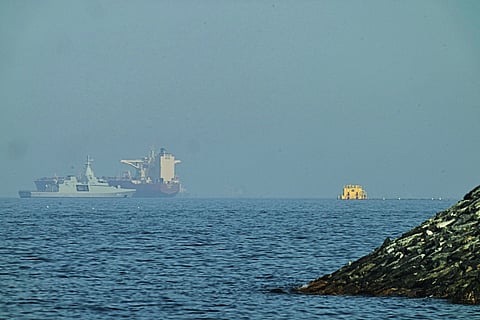

DUBAI: Iran said it was reviewing the latest American proposals to end the war after U.S. President Donald Trump threatened the country with a new wave of bombing unless a deal is reached that includes reopening the crucial Strait of Hormuz to international shipping.
Hope that the two-month conflict could soon be over buoyed international markets Thursday, a day after the U.S. military fired on an Iranian oil tanker attempting to breach the American blockade of Iran's ports. The developments followed days of mixed messages from the Trump administration over its strategy to end the war.
Meanwhile, U.S. Secretary of State Marco Rubio discussed peace efforts in the Middle East at the Vatican. Rubio met with Pope Leo XIV, whose opposition to the Iran war has led to open sparring with Trump.
Trump posted on social media Wednesday that ending the war and resuming oil and natural gas shipments disrupted by the conflict depends on Iran accepting an agreement, which he did not detail.
"If they don't agree, the bombing starts," Trump wrote.
A fragile ceasefire between the U.S. and Iran has largely held since April 8. But in-person talks between the two countries hosted by Pakistan last month failed to reach an agreement. The war began Feb. 28, when the U.S. and Israel launched strikes against Iran.
Pakistan says it expects a deal soon
"We expect an agreement sooner rather than later," Pakistani Foreign Ministry spokesperson Tahir Andrabi said Thursday. "We hope the parties will reach a peaceful and sustainable solution that will contribute not only to peace in our region but to international peace as well."
But he declined to give a timeline, saying Pakistan would not disclose details of the ongoing diplomatic efforts.
Asked whether Pakistan was expecting any response from Iran later Thursday, Andrabi said: "I will not comment on specifics or the movement of the messages."
Pakistani Prime Minister Shehbaz Sharif, speaking in televised remarks, said Islamabad remained in "continuous contact with Iran and the United States, day and night, to stop the war and extend the ceasefire."
A shifting narrative of the war
The Trump administration's messaging throughout the Iran war has been shifting and often contradictory. This week, the president and his aides presented a dizzying narrative over the U.S. strategy to unblock the Strait of Hormuz and wrap up the war that drastically changed over the course of mere hours.
Iran has effectively shut the strait, a vital waterway for the shipment of supplies of oil, gas, fertilizer and other petroleum products, while the U.S. is blockading Iranian ports.
On Wednesday, a U.S. fighter jet shot out the rudder of an Iranian oil tanker in the Gulf of Oman as it tried to breach the American blockade, U.S. Central Command said in a social media post.
Iran creates agency to control passage at Hormuz
Iran has established a new government agency to approve transit and collect tolls from shipping in the strait, shipping data firm Lloyd's List Intelligence said Thursday. The move has raised concerns about eroding the freedom of navigation on which global trade depends.
The agency, called the Persian Gulf Strait Authority, is "positioning itself as the only valid authority to grant permission to ships transiting the strait," Lloyd's reported in an online briefing.
The agency formalizes an existing, albeit murky, vetting lane that takes vessels through the strait's northern waters near the Iranian coastline. Iran controls which ships are allowed to pass and, for at least some vessels, imposes a tax on their cargo.
Maritime law experts say Iran's demands to vet or tax vessels violate international law. The United Nations Law of the Sea treaty calls for countries to permit peaceful passage through their territorial waters.
Trump suggests U.S. might force a deal with Tehran
Trump insisted Wednesday that Iranian officials want to end the war.
"We're dealing with people that want to make a deal very much, and we'll see whether or not they can make a deal that's satisfactory to us," the president said.
By threatening more bombing, he suggested the U.S. could ultimately force a settlement.
A spokesman for the Iranian Foreign Ministry, Esmaeil Baghaei, told state TV on Wednesday that Tehran was still examining the latest U.S. proposal.
Baghaei said Iran had "strongly rejected" U.S. proposals reported by the news outlet Axios, which said provisions includes a moratorium on Iranian uranium enrichment, lifting of U.S. sanctions, distribution of frozen Iranian funds and opening the strait for ships.
Saudi official says kingdom did not support US effort to reopen strait
Trump did not consult with U.S. ally Saudi Arabia before launching the short-lived effort to force open a shipping passage through the strait, according to a Saudi official who was not authorized to discuss the matter publicly and spoke on condition of anonymity.
"We told them that we are not part of this and that they can't use our territories and bases for this," the official said Thursday.
The official said Saudi Arabia sent a message to Iran that the kingdom would not be involved in U.S. attacks related to Trump's attempt to reopen the strait.
Trump suspended the effort, dubbed Project Freedom, during its second day Tuesday. Only two American-flagged merchant ships are known to have passed through the U.S.-guarded route. The U.S. military said it sank six Iranian small boats threatening civilian ships.
Hundreds of merchant ships remain bottled up in the Persian Gulf, unable to reach the open sea without passing through the Strait of Hormuz. The strait's closure has sent fuel prices skyrocketing, rattled the global economy and put enormous economic pressure on countries, including major powers such as China.
On Thursday, the price of Brent crude oil stabilized at around $100 a barrel as investors waited to see whether the strait would reopen.
In other developments, French President Emmanuel Macron said Wednesday that France's aircraft carrier strike group was moving into the Red Sea in preparation for a potential French-British mission to restore maritime security in the Strait of Hormuz as soon as conditions allow.
