
Pakistan on Monday called on Afghanistan to address the security concerns of neighbouring countries, particularly the threat of terrorism, saying lasting regional cooperation depended on peace, stability and trust among states.
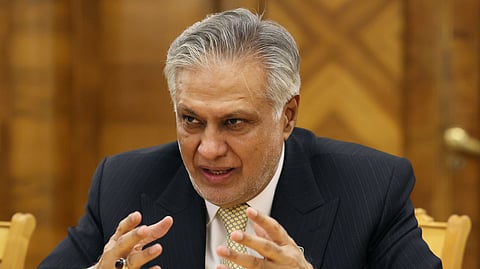
Addressing the Council of Ministers meeting of the Economic Cooperation Organisation (ECO) in Islamabad, Pakistan's Deputy Prime Minister and Foreign Minister Ishaq Dar said a peaceful and stable Afghanistan would benefit not only its people but also the wider region by opening up opportunities for trade, transit and economic cooperation.
"Pakistan desires a peaceful, prosperous, and stable Afghanistan, fully integrated within the ECO framework and at peace with itself and all its neighbours," Dar said.
"At the same time, meaningful progress requires the Afghan authorities to address the legitimate security concerns of the neighbouring countries, particularly the threat of terrorism," he added.
His remarks come amid strained relations between Islamabad and Kabul over Pakistan's allegations that militant groups, particularly the Tehreek-e-Taliban Pakistan (TTP), operate from Afghan territory and carry out attacks inside Pakistan.
The Afghan Taliban have repeatedly denied the allegations, asserting that they do not allow Afghan soil to be used against other countries. The two neighbours have also witnessed repeated border clashes and exchanged accusations over cross-border militancy.
Emphasising the importance of regional connectivity, Dar said economic partnerships required a secure environment and mutual trust among countries.
"Regional connectivity rests on more than the routes that link us. It depends upon trust between states and confidence that international commitments will be honoured," he said, adding that unresolved disputes and failure to meet international obligations could undermine trust and hamper economic progress.
The two-day ECO Council of Ministers meeting, which began on Sunday, is being attended by officials from all 10 member states — Pakistan, Afghanistan, Azerbaijan, Tajikistan, Iran, Turkiye, Kazakhstan, Turkmenistan, Kyrgyzstan and Uzbekistan.
Iranian Foreign Minister Abbas Araghchi arrived in Islamabad to participate in the 30th meeting, Pakistan's Foreign Office said. Delegations from other member countries have also reached the capital to finalise the agenda and draft the Islamabad Communique.
A Senior Officials Meeting was held on Sunday under the chairmanship of Pakistan's Foreign Secretary Asim Iftikhar Ahmad. It was attended by senior representatives of ECO member states, the organisation's secretariat and its specialised agencies and regional institutions.
Pakistan, which holds the ECO chairmanship for 2026-27, aims to advance regional cooperation under the theme 'Reviving Regionalism for a Resilient ECO'.
The ECO is a regional intergovernmental organisation established in 1985 by Pakistan, Iran and Turkiye to promote economic, trade and regional cooperation.
(With inputs from PTI)
