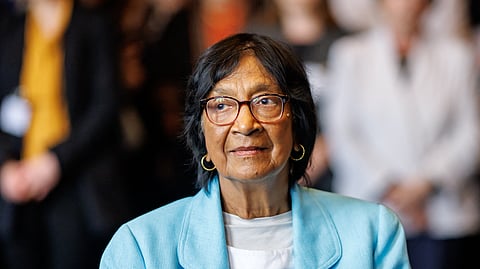

NEW DELHI: At 85, Navi Pillay has received the 2026 Nobel Peace Prize for a career spent challenging the impunity of the perpetrators of international crimes. The former United Nations High Commissioner for Human Rights has worked across some of the world’s most politically contentious conflicts, from Rwanda to Gaza. One of Navi Pillay’s most significant contributions began with a question the courts had long sidelined -- could rape itself be an act of genocide?
As a judge at the International Criminal Tribunal for Rwanda, she pivoted the landmark 1998 judgment that recognised it as such. Her insistence that women’s suffering be counted was rooted in her life forged from discrimination and defiance.
Born Navanethem Pillay in Durban, South Africa, in 1941, she grew up poor. Her grandfather had been brought from Tamil Nadu to work on sugar plantations in conditions she later described as “semi-slavery.” Her father was a bus driver, and the family struggled to provide for eight children. University education was far from assured. But when a school principal recognised her potential, residents of her working-class community of Clairwood pooled money to help send her there.
At the University of Natal, racial discrimination was woven into everyday life. After graduating, she approached law firms for work. Most refused to employ her unsure as to whether white secretaries could take instructions from a black lawyer.
In 1967, she opened her own law practice, the first woman to establish a law firm in Natal Province. She defended anti-apartheid activists, including her husband, Gaby Pillay, and challenged abuses against political prisoners on Robben Island. Her work helped secure prisoners’ access to lawyers and fairer disciplinary proceedings.
Apartheid certainly taught her how the law could become an instrument of injustice. It also convinced her that legal systems needed to be challenged from within and beyond national borders. In 1995, Pillay became the first non-white woman appointed to South Africa’s High Court. The following year, she began serving at the Rwanda tribunal, established to prosecute those responsible for the 1994 genocide, in which an estimated 800,000 people were killed. While the killing of thousands grabbed headlines, the systematic rape of women was considered a lesser crime. Investigators struggled to document sexual violence as survivors were reluctant to recount their experiences to male officials who lacked both training and empathy.
The case of Jean-Paul Akayesu, a former mayor of Taba whose commune witnessed widespread killings and sexual violence, became a turning point. Rape was absent from the original charges. In 1998, Akayesu was convicted of genocide and crimes against humanity, including rape. Pillay has always been careful to credit the women who testified for making that landmark judgment possible.
Early in her career, she later recalled, she had been impatient with women who came to her in tears to report domestic violence. She mistook their helplessness for weakness and lack of initiative. Listening to them taught her that abuse was a larger social problem. That lesson extended beyond the courtroom. In 1986, she co-founded South Africa’s Advice Desk for the abused and later helped establish Equality Now, an international women’s rights organisation.
She also contributed to efforts to secure gender equality in South Africa’s post-apartheid constitutional settlement. Pillay went on to serve as a judge at the International Criminal Court from 2003 to 2008 before becoming UN High Commissioner for Human Rights, a position she held from 2008 to 2014. She pushed for human rights to be integrated into the UN’s work on development, peace and security, while raising issues including caste discrimination and the rights of LGBTQI people.
Her later work has brought her into the centre of more politically charged disputes. From 2021 to 2025, she chaired the UN Independent International Commission of Inquiry on the Occupied Palestinian Territory, including East Jerusalem, and Israel. The commission concluded that Israel had committed genocide in Gaza, a finding Israel rejected.
The controversy, however, highlighted the limits of international investigations when legal conclusions collide with geopolitical interests. Then, from the apartheid courts of South Africa to the Rwanda tribunal, she has challenged institutions to look beyond established priorities and recognise the suffering they might otherwise overlook. For Navi Pillay, the path to justice has often begun with a witness whom others were unwilling to hear!
