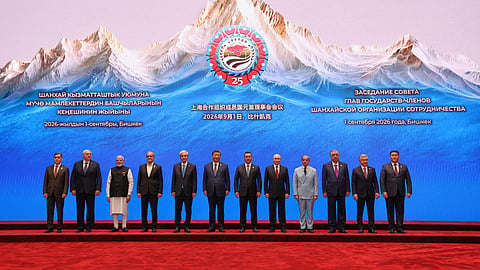

NEW DELHI: The Shanghai Cooperation Organisation (SCO) on Tuesday condemned US military strikes on Iranian territory, warning that the attacks had caused civilian casualties and economic damage and posed “serious risks to international peace, security and stability”, as the grouping adopted the Bishkek Declaration.
The declaration expressed “deep concern” over developments in West Asia and around Iran and reaffirmed the organisation’s opposition to military action against the Islamic Republic.
“Member states express deep concern over developments in the Middle East and around Iran,” the declaration said, reiterating the SCO’s “previously stated position condemning military strikes on the territory of the Islamic Republic of Iran”.
It said such actions had resulted in “numerous civilian casualties and significant damage to the country's economy” and amounted to violations of “the principles and norms of international law and the UN Charter”.
The statement also expressed condolences to Iran over the death of Supreme Leader Ayatollahj Ali Khamenei and to the families of those killed in the conflict.
“Member States express their sincere condolences to the people and Government of the Islamic Republic of Iran on the tragic death of Supreme Leader Seyyed Ali Khamenei, and to the families of the victims,” it said.
The SCO called for the conflict to be resolved exclusively through diplomatic and political means, while backing efforts aimed at reducing tensions in the region.
“Member States, reaffirming their support for the sovereignty and territorial integrity of the Islamic Republic of Iran, advocate a resolution to the conflict solely through political and diplomatic means,” the declaration said.
The Iran section of the statement also linked the wider Middle East crisis to the Palestinian question, saying a comprehensive settlement was essential for regional stability.
“Member States note that the only possible way to ensure peace and stability in the Middle East is a comprehensive and just settlement of the Palestinian question,” it said.
The strong language on Iran came as the SCO, which includes China, Russia, India, Pakistan, Iran and Central Asian states, sought to project itself as a voice for a multipolar international order while stressing its opposition to bloc politics and military confrontation.
The declaration also reaffirmed the group’s position against terrorism. Member states said attempts to exploit terrorist, separatist and extremist groups for “selfish purposes” were inadmissible and declared that “double standards” in combating terrorism were unacceptable.
The Iran issue was placed alongside Afghanistan in the declaration’s security assessment. SCO members reaffirmed their commitment to an Afghanistan that is “independent, neutral and peaceful” and free from terrorism, war and drugs.
They also stressed that an inclusive Afghan government was necessary for lasting stability.
“Member States reiterate that the formation of an inclusive government with broad participation of representatives of all ethno-political groups of Afghan society is the only way to achieve lasting peace and stability in that country,” the declaration said.
The Bishkek Declaration further opposed unilateral coercive measures that it said violated the UN Charter and international law, and called for greater cooperation in energy, trade, transport and finance.
