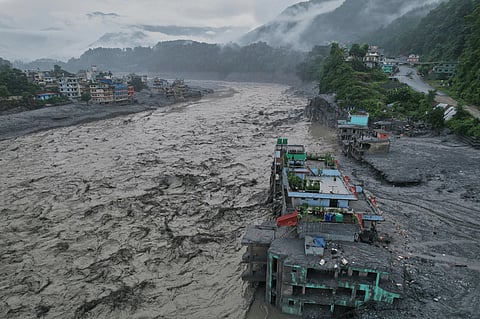

The death toll from the devastating glacial floods that struck Nepal and Tibet climbed to at least 903 on Monday, while the number of people missing in Nepal rose to 4,247, as rescuers battled mud and debris for a sixth day to reach those stranded in affected areas.
Bodies have been recovered from all eight affected districts in Nepal as rescue teams race against time to search for those missing and free people trapped by the disaster.
The massive wave of freezing water, rocks and debris struck villages and towns in northern and central Nepal on August 26 after what the US Geological Survey said was a glacial collapse near the Nepal-Tibet border. At least 17 bodies were also recovered downstream in India.
Nepal's National Disaster Risk Reduction and Management Authority (NDRRMA) said 903 bodies had been recovered so far.
Chitwan accounted for 272 bodies, followed by Nawalparasi East with 207, Nawalparasi West with 151 and Gorkha with 62. Another 95 bodies were recovered from Nuwakot, 55 from Dhading, 37 from Tanahu and 24 from Rasuwa.
The NDRRMA said 4,247 people remained missing in Nepal, including 85 security personnel and 320 foreigners. Across Nepal and Tibet, the number of people unaccounted for is approaching 5,000.
China has reported 16 deaths and 546 people missing in Tibet.
Rescue teams have been working continuously in treacherous conditions, with teams from China, India and South Korea assisting Nepali authorities.
Particular efforts have been focused on hydropower projects, where hundreds of workers remain unaccounted for. Nepali authorities believe around 100 workers could still be alive inside several tunnels, while 933 hydropower workers are listed as missing.
Three bodies have so far been recovered from two tunnels. At the Upper Trishuli 3A hydropower site, rescuers broke through into the upper portion of a mud-filled tunnel and pumped air inside before using drilling and excavator equipment to clear the debris.
Nepal Prime Minister Balendra Shah Shah said, adding that rescue operations were continuing.
Nepali Armed Police spokesman Netra Bahadur Karki said rescue teams had now reached most affected areas either by road or helicopter, although difficult terrain, damaged roads and poor communications continued to hamper operations.
The floods washed away roads, destroyed power plants and smashed dozens of bridges, leaving entire communities cut off and thousands of people homeless.
Amid the devastation, rescuers also managed to save a six-year-old girl who was pulled from the mud four days after the disaster. Police later found her crying for her mother and reunited her with her parents.
"Her body was trapped in mud, but her head was outside," Karki said. "She is out of danger and recovering at a hospital and has reunited with her family."
Meanwhile, authorities have begun burying some unidentified bodies in mass graves after collecting DNA samples, as mortuaries have struggled to accommodate the large number of dead.
Nepal has appealed for international assistance, saying it needs more than 1,000 freezer units to preserve bodies while families attempt to identify missing relatives.
Families desperate for information have been examining images of recovered bodies at community centres. Among those reported missing are hundreds of foreign nationals, including trekkers and Hindu pilgrims travelling towards Tibet's Mount Kailash.
The disaster has also raised fresh concerns over the impact of climate change on the Himalayas. The US Geological Survey said the floods were triggered by a glacial collapse, although the precise cause remains unclear. Scientists have warned that Himalayan glaciers are melting faster as global temperatures rise, increasing the risk of glacial-related disasters.
Nepali Foreign Minister Shisir Khanal said the country was among the major victims of the changing climate and its effects.
The humanitarian needs are enormous, with tens of thousands of people affected and many forced to shelter in temporary facilities amid heavy rain.
"This is an unfolding disaster," UN children's fund official Abiodun Banire told news agency AFP, describing the needs of those affected as vast.
In Tibet, more than 2,000 personnel are involved in rescue operations, but access to the disaster's epicentre at Gyirong Port remains difficult. Chinese state media said rescuers had advanced only 285 metres towards the area on Sunday.
The glacial collapse also created huge lakes dammed by unstable debris, posing an additional threat to rescue teams.
With Nepal's infrastructure severely damaged and entire communities swept away, the government has warned that reconstruction costs could run into billions of dollars. Foreign governments have pledged millions of dollars in humanitarian assistance as rescue and relief operations continue.
(With inputs from AFP)
