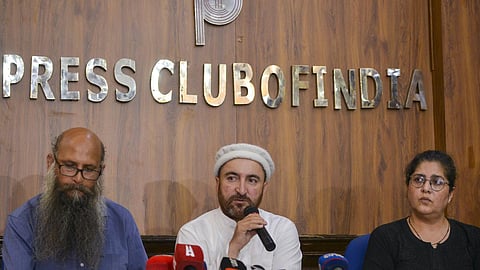

SRINAGAR: Amid a deadlock in talks between the Union Ministry of Home Affairs (MHA) and Ladakh leaders, the Leh Apex Body (LAB) has released five documents exchanged during negotiations between May and October 2026, detailing differences over constitutional safeguards, the proposed elected body and administrative powers.
The documents include minutes of a meeting, the Centre’s draft proposals, a joint counter-proposal by the LAB and the Kargil Democratic Alliance (KDA), and a comparison of the positions taken by the two sides.
Their release comes amid public speculation and differing accounts of the progress of negotiations. The latest round of talks, scheduled to be held in New Delhi on October 22, did not take place as the MHA did not invite Ladakh leaders.
In an appeal to the people of Ladakh, LAB chairman Chering Dorjay said transparency was essential while the region’s democratic aspirations, constitutional safeguards and administrative arrangements were under discussion.
“Amid growing speculation, allegations, and attempts to misrepresent the position of LAB, particularly following recent remarks attributed to Chief Secretary Ashish Kundra and the meeting convened by the Citizen Forum of Ladakh, headed by Thupstan Chewang, I consider it my responsibility, on behalf of LAB to place before the people of Ladakh the relevant documents and drafts exchanged between LAB and MHA,” Dorjay said.
He said the local leadership had expected the Chief Secretary’s office and the MHA to make the records available for public consultation. “After that did not happen, LAB decided to release the documents independently”.
Dorjay urged people to assess the negotiations through official records rather than rumours or selective interpretations. He said the leadership’s position on protecting Ladakh’s interests should not be seen as a confrontation with the Centre.
“Our firm stand on protecting the interests of our people must not be misconstrued as confrontation,” he said.
The documents outline the principal stages of negotiations under the High-Powered Committee (HPC), which has been discussing constitutional safeguards and governance arrangements for Ladakh.
The first document contains the minutes of the fifth meeting of the HPC sub-committee, held in New Delhi on May 22 and endorsed in Leh on July 3. It records an initial consensus on creating a Union Territory-level elected legislative body through a special constitutional arrangement under a proposed Article 371K, along with greater control over civil administration.
The minutes state that a customised, sui generis model suited to Ladakh would be adopted. “It was decided that a draft proposal covering the powers and functions (executive, financial and legislative) of this UT-level elected body in harmonious relations with the PRIs would be prepared for further discussion and fine-tuning”.
The second document, an MHA presentation titled Moving Towards Consensus, was submitted on September 9. It outlined possible executive, legislative and financial powers for a UT-level body under Article 240 of the Constitution and listed seven administrative questions for further discussion.
The LAB and KDA rejected the proposed framework, arguing that it did not provide adequate constitutional protection or democratic authority.
The third document, submitted on October 15, contains their responses to the MHA’s questions and a draft accord, memorandum of understanding or joint declaration setting out their demands. On the same day, the MHA submitted a 32-page document titled Proposed Constitutional and Statutory Framework for a Union Territory-Level Body in the UT of Ladakh.
The fifth document, dated October 19, compares the proposals submitted by the MHA and the LAB-KDA.
The central disagreement concerns the legal basis, powers and autonomy of the proposed governing body.
The MHA’s draft envisages a two-stage process. The first would involve a constitutional amendment to establish the legal foundation for a UT-level body. The second would rely on regulations issued by the President under Article 240 to define its composition, powers and functioning.
Under the MHA proposal, the body would be a permanent legal entity capable of holding property, entering into contracts and initiating or defending legal proceedings.
The draft identifies around 27 local subjects over which the body could exercise regulatory powers, including land records, land surveys, land alienation, local environmental planning, art, culture and certain non-reserved forests. Natural resources and reserved forests are excluded from the proposed legislative domain.
The draft leaves open different options for representation, including direct elections from territorial constituencies or indirect elections through members of the Ladakh Autonomous Hill Development Councils (LAHDCs) and Panchayati Raj Institutions. It also allows for nominated seats representing religious minorities, women and subject experts.
However, the proposal retains substantial administrative oversight for the Lieutenant Governor or Administrator and the Union government. The Administrator would have inspection, review and direction powers and could dissolve the body under specified circumstances involving persistent default or abuse of authority.
The LAB-KDA proposal instead seeks a separate Article 371K through a customised constitutional amendment, establishing a distinct framework for Ladakh rather than relying primarily on statutory regulations.
It proposes a Legislative Assembly elected directly from territorial constituencies following fresh delimitation, with executive authority vested in a Council of Ministers headed by a Chief Minister.
The proposal states that the elected executive would be known as the Government of Ladakh and the legislature as the Legislative Assembly of Ladakh.
“The government of Ladakh be a democratically elected government exercising constitutionally guaranteed legislative, executive and financial authority in accordance with Article 371 K and there shall be a council of ministers headed by Chief Minister”.
Under the proposal, the Lieutenant Governor would ordinarily act on the aid and advice of the elected cabinet, with discretionary powers limited to specifically defined reserved matters. The Assembly would have legislative powers over subjects in the State List and Concurrent List of the Constitution’s Seventh Schedule, subject to the proposed amendment.
The LAB and KDA also seek safeguards against the application of parliamentary laws concerning land, natural resources, customary practices and community rights without a specified consent or resolution mechanism.
Control over the civil administration is another major point of disagreement. Under the MHA framework, administrative personnel, including a Chief Executive Secretary of Principal Secretary or Secretary rank, would be appointed by the administration to implement the proposed body’s decisions. Staffing would be based on functional requirements, without transferring overall cadre control to elected representatives.
The LAB-KDA proposal seeks authority over transfers, postings, work allocation and disciplinary supervision of officers serving under the elected government. It also calls for a separate administrative cadre for Ladakh and an independent Public Service Commission for local recruitment.
It proposes that the Chief Secretary head Ladakh’s administrative machinery and serve as Secretary to the Council of Ministers.
“The Chief Minister of Ladakh should be reporting authority for the Chief Secretary for the purposes of All India Service (Performance Appraisal Report) Rules 2007”.
The LAB and KDA have also sought relief for people affected by the violence in Leh on September 24, 2025, in which four people were killed and more than 40 injured. They are demanding the unconditional withdrawal of criminal cases registered in connection with the protests and increased compensation for those killed and injured. More than 80 people were booked in connection with the violence.
