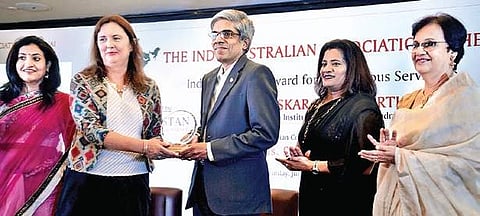

CHENNAI: There are three areas of major research interest that both India and Australia can focus on — energy, water and healthcare,” said Dr Bhaskar Ramamurthi, director, Indian Institute of Technology, Madras, in his acceptance speech when conferred with the Indo-Australian Award for Meritorious Service 2019 on Saturday.
He explained that solar energy could help in combatting the problems of carbon dioxide emissions, and also highlighted one of the biggest drawbacks of solar energy. “We need electricity throughout the day. A big problem that all countries are facing when it comes to solar energy is how to deal with the burst of energy in the morning and it fizzling out in the evening. India and Australia should look at transcontinental solar energy. We should be able to move this energy in a way that India can receive power three-four hours earlier in the morning and Australia can receive it three-four hours longer at night. This is a large scale engineering challenge and there is a lot of science to be cracked before, but it is something that academic groups can look at.”
Discussing water, Dr Bhaskar Ramamurthi said that in Chennai, there wasn’t a fundamental problem in the freshwater supply but rather the mismanagement of the resource that was leading to scarcity. He said it was essential to “leave the rivers alone and learn to treat water well and reuse it”.
As for healthcare, Dr Bhaskar said he was not talking about robotic surgery, as important as he felt it was. According to him, another aspect that is often ignored when it comes to healthcare that needs to be addressed is caregiving. “As people get old, they want to be around people who love them and that is getting harder for people to do due to various constraints. Assisted technologies and robotic technologies will have to come into play. And it is much harder to develop this than robotic surgery as it is very difficult to replicate what human touch and interaction provides. Even something like holding an elderly person’s hand firmly is something that can be extremely complex.” He said that these three areas would be very good for start-ups to focus on. He was certain that the breakthroughs in these fields will come from start-ups. He emphasised that these innovations will not only help both the countries but will be beneficial for the rest of the world as well.
Susan Grace, the Australian Consul General to South India was the chief guest at the event and spoke of Australia’s strong ties with India and how she expected it to take shape going forward. “In the coming years, we hope for increased diplomatic presence in south India. The governments of both countries agree that the relationship will only go from strength to strength... Australia is not the only country that is courting Indian universities like IIT, but we hope to be the partner of choice for an institution like IIT Madras as education is seen as a key sector in the India Economic Strategy,” she said. The Indo-Australian Association was started in 1984 and it recognises remarkable individuals of either country who have made significant social contributions in one field or the other.
President of the Association Dr Susan Marthandan, vice president Eugenie Pinto, and secretary Leena Ashok were also present at the event. Guests included diplomats from consulates, business honchos and members of the Indo-Australian Association.
