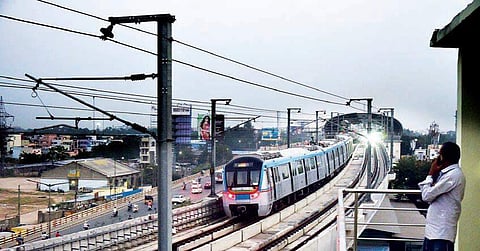

HYDERABAD: With the much-awaited rail going live on Wednesday, a day after it was inaugurated by the prime minister Narendra Modi, several students could not stake claim to the 'first day first ride'.
Serpentine queues at the metro stations and high fares for those commuting short distances are likely to keep student community away from metros, in the future too.
N Kavya an engineering student of Gokaraju Rangaraju Institute of Engineering and Technology on the Bachupally Road and residents of Sanathnagar, takes RTC buses and shared autos to commute to and fro from her home to college. She along with her two friends wanted to take the metro from JNTU station to check if it is as hassle-free as it is being touted.
"We waited an hour to get the tokens. Both counters had long queues so we have decided to give the metro a miss and take our usual mode of transportation. If the waiting time is so long what is the point of the metro. Buses are very frequent on this route anyway," said Kavya while her friend rued that they could not even take a selfie during the metro ride.
All stations have one electronic ticket vending machine and two counters. At the JNTU station, however, only the e-ticket machine and one counter were operational, which led to the large crowds at the counter. A similar situation was seen at the KPHB station.
Mohammed Munaf, an intermediate student from Yousufguda takes coaching in SR Nagar and shells out Rs 20 as fare on shared autos. "If I take the Metro from SR Nagar to Ameerpet, I will pay Rs 10 for Metro fare and then as much amount from there to Yousufguda on auto. For short distances, autos are the best bet," he said.
Though the minimum fare for HMR has been fixed at Rs 10 and the maximum at Rs 60, with fares varying according to the distance, Metro is likely to face competition from RTC buses, shared seven-sitter autos and even cab aggregators like OLA and Uber, which are the preferred modes of transportation for the students.
The minimum fare for ordinary buses is Rs 8, for metroline it's Rs 10 and AC it is Rs 15. Cabs charge a minimum of Rs 50 while for shared autos it is Rs 10. However, passengers travelling via the Metro will be charged Rs10 for 2 km, Rs 15 for travel up to 4 km, Rs 25 (4-6 km), Rs 30 (6-8 km), Rs 35 (8-10 km), Rs 40 (10-14 km), Rs 45 (14-18 km), Rs 50 (18-22 km), Rs 55 (22-26 km) and Rs 60 (more than 26 km).
Meanwhile, Sri Vidya, a Btech student said she is cutting down on the travel time by more than half, thanks to the Metro. A resident of Mettuguda, she is a student of JNTU, Kukatpally. "Instead of 1.5-2.5 hours that I spend daily on commuting one way in the bus, today I reached my destination in just 40 minutes. It was so good," she gushed.
Though she generally spends Rs 60 on buses, Metro costs her Rs 110, an amount she said it is nothing compared to its advantage. "If I missed the bus I would have to wait for 20 minutes for the next one to come. There are no bus shelters as well. Waiting time of 10-15 minutes at the Metro station is nothing compared to all these hassles. I am very happy," she added.
Unkempt Ameerpet metro station, missing signage to indicate which exit will take you where, long queues at the ticket counter and no reserved coach for women were some of the other issues students complained about.