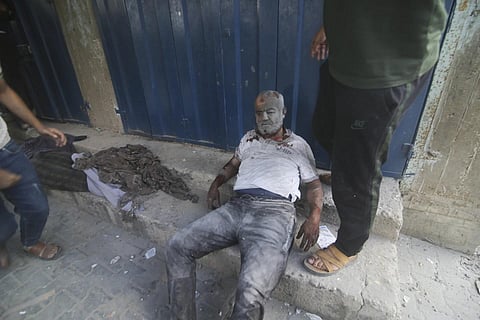

Heartbreaking images continue to emerge out of Gaza. The videos and photographs flooding social media show, among others, injured children looking helpless and crying, a bleeding infant undergoing treatment at a hospital, and people reacting to the massacre of their families -- all in Israeli bombardments. The humanitarian aid is yet to reach the people in Gaza.
"Are we going to die?" These are the messages being received from "our colleagues and friends," said the United Nations Relief and Works Agency for Palestine refugees.
"We have so far lost at least 15 colleagues from in Gaza and this is a very heavy toll for us,” the agency said.
It described the situation in the Gaza Strip as "unbearable."
The United Nations Human Rights office on Tuesday said that with a staggering 4,200 people killed, over one million people displaced in just 10 days, and large areas in the Gaza Strip reduced to rubble, there is a grave fear about the toll on civilians in the coming days.
According to the World Health Organization, there have been 2,800 deaths in Gaza, with 11,000 wounded, since 7 October, when Israel began retaliatory strikes for the attack Hamas launched on southern Israel.
The majority of Gaza’s population are descendants of refugees who were displaced or forced to flee their homes during the 1947-49 conflict in which more than 750,000 Palestinians were forcibly displaced from their towns and villages – a conflict referred to by Palestinians as the Nakba, Amnesty International said.
Describing their plight, Munir Radwan, a university professor told Amnesty, “Our parents were expelled from their homes in 1948 during the Nakba. We lost our house which was destroyed in the August 2022 offensive; our rebuilt house was destroyed again…all our lives we have known nothing but a series of displacements.”
Amnesty International on Tuesday called upon Israel to lift the siege of Gaza, restore the electricity and water supply and allow humanitarian access. Its forces must abide by international humanitarian law and take all feasible precautions to protect civilians and refrain from indiscriminate and disproportionate attacks
Meanwhile, the mainstream media has drawn flak for the coverage of Gaza. After CNN's Sara Sidner was forced to apologize for defending Israeli claims that Hamas beheaded babies, the BBC apologized for reporting that pro-Palestine demonstrators were backing Hamas.
In the UK, British Prime Minister Rishi Sunak and several of his ministers have criticized BBC for not calling Hamas a "terrorist organization."
According to reports, around 250 protesters gathered outside the BBC's main headquarters in London on Monday over the British broadcaster's "continued refusal to call Hamas terrorists".
The BBC however said in a statement that it had given "careful consideration" to its coverage of the conflict.
"Careful consideration has been given to all aspects of our coverage to ensure that we report on developments accurately and with due impartiality in line with the BBC editorial guidelines, which are publicly available.
"The BBC, along with many other UK and global news organisations, does use the word 'terrorist', but attributes it. We have made clear to our audiences that Hamas is proscribed as a terrorist organisation by the UK and other governments," it added.
Pro-Palestinian groups have also targeted the BBC, covering Broadcasting House headquarters in red paint last week and accusing it of having "blood on its hands".
An anthropologist and author Sami Hermez in a message posted on platform X said that, "The media for this war will be studied for decades for the way it manufactured consent for brutal crimes and how the Israel lobby mastered the media narrative and created a total blackout."
American freelance journalist and writer Ben Ehrenreich made an appeal to "Editors of good conscience" to make a greater than usual effort to publish actual Palestinians. "Friends in Ramallah are telling me they can't place pieces in US outlets," he said on Platform X.
While the massacre of Palestinians continues in Gaza, the arrests of people and activists voicing their support for Palestinians have also been reported from several countries.
Amnesty International said the decision of the French government to ban all demonstrations in support of Palestinians rights constitutes a serious and disproportionate attack on the right to demonstrate. "Under international law a ban on demonstrations must be considered as a last resort," it said.