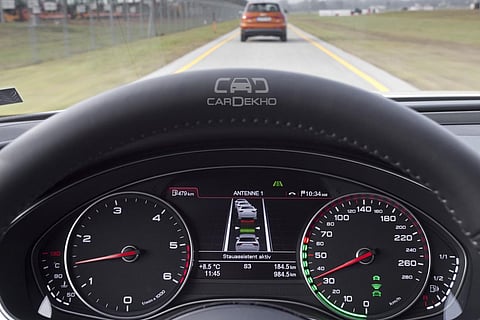

We often read about the Cruise Control feature when we go out buying a C-segment sedan or some SUVs like XU500 or Scorpio. And also nodding our heads when the sales executive explains about the system. It makes one wonder what would be the need of such system. I mean you can just control the car manually as we always do. But wait, what if you are on serious tripping business and your car is the only fast way transporting you to your destination. Then, a regular drive of average 100 kilometers can noticeably exhaust you. Until you have a system like Cruise Control, in which you can set the required speed and then take your foot off throttle pedal. Though, the vehicle will only remain in Cruise Control till you apply the brake (or depress the clutch), but still it is very useful as we have pretty long stretches of highways. Lets take a look of how Cruise Control came into existence and the tech behind it.
History
At the very initial stage in early 20th century, governors (speed controllers) were used by a manufacturer named Wilson Pilcher. But it was rather primitive and the modern system came into existence from its invention by a mechanical engineer named Ralph Teetor. And this guy was no ordinary man, as not only the fact that he was blind is interesting, but why he made this invention is even more amusing. As one day he was going with his lawyer who was driving the car and who would constantly accelerate and decelerate the vehicle while talking and listening. Teetor was so much annoyed by this rocking motion and he decided to make a speed control device. Precisely, in 1945, after almost a decade of tinkering with the idea and development he got this system patented.
Cruise Control: The one we know today
The electronic Cruise Control in most simple explanation, is a mechanism that monitors speed, time and throttle position of the vehicle. The Electronic Control Units (ECU) commands the actuator to open and shut the throttle, hence maintaining the speed selected by the driver. The actuator is a vacuum driven servomechanism. The vacuum is made by the exhaust manifold via a small bleed pipe. But with the introduction of latest drive by wire technology, vacuum type cruise control is losing its existence in modern cars.
Integration of Cruise Control becomes more easier if a vehicle is using electronic throttle control commonly known as drive by wire technology, as mentioned earlier. As the ECU of cruise control works easily with the latest engine management system.
To shut the Cruise Control, one just needs to press ‘Cancel’ or ‘ON/OFF’ or just a manual pressing of the clutch disengages it. Moreover, to return to Cruise one needs to press ’Resume’ to return to its previously set speed.
Advantages of CC
· It is very useful for long highway cruising as it considerably drops the fatigue and tiring level.
· It offers linear acceleration with less use of clutch which eventually improves fuel efficiency.
· Most importantly, it reduces the error quotient of the driver as it can maintain speed limits to escape fines.
Disadvantages of CC
· New users would take some time to get habitual to this system.
· Not many cars out here are offered with this system.