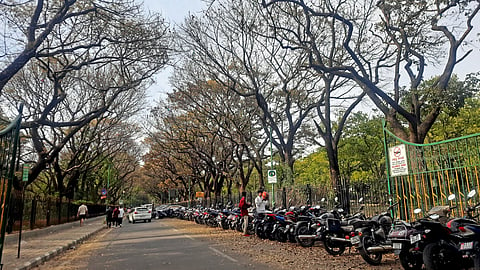

Bengaluru’s tryst as a metropolis, with stagnant traffic, has been a living fact for its residents for long. Throughout the expanse of the city, unruly drivers, poor infrastructure, and resultant traffic snarls abound. The recent ruling by the government allowing vehicular traffic inside Cubbon Park every second and fourth Saturday nights, should raise some serious eyebrows – not simply in isolation, but also for what it means for the future identity of the once-beloved Garden City.
For those unaware, the ruling allows vehicular traffic between 7pm and 10pm on applicable Saturday nights, as opposed to the park being completely free of traffic on weekends, except pedestrian traffic. It is important to note that this is a ruling enforced on a ‘trial-basis’ period of three months, although that makes one wonder if the period is too long to begin with, and if the damage caused would be irreparable. For ecologist and ornithologist MB Krishna, the additional damage is marginal. “The traffic is being extended for three hours every fortnight which amounts to an additional 2.7 per cent,” he mentions. Krishna believes that instead of viewing this marginal percent in isolation, it is important to contextualise this ruling in the larger picture of rapid erasure of greenery and tree cover. Krishna talks in terms of energy, citing the unsustainable equation between India’s population growth and the proportionate decline in forest cover; it takes no more than a layperson to understand the basic oxygen requirements of an individual, and the terrifying prospect of its only natural source being directly and consistently under attack.

For birdwatcher Prashanth Badarinath, this, even of itself, is not without significance. “Large parks , unlike the smaller BBMP parks, offer a lot more nichés for migrant and resident birds. Knowing that traffic is heavy on Saturdays, it would be wise of the authorities to leave the last few lung spaces of the city undisturbed. One would think it is just a brief day or two in a month, but the volume of traffic can have untold effects,” he asserts, continuing to echo Krishna’s sentiments by stating, ‘such relaxation in rules should not set a precedent to relax them further’.
Badarinath’s statement should usher the residents of the town to acknowledge that the gravity of the problem moves beyond Cubbon Park’s verdant greenery and flora. Like any flourishing ecosystem, the park’s trees, bushes, and water bodies are home to innumerable fauna, including but not limited to the avian kind. As Ulhas Anand, a birdwatcher and co-founder of EcoEdu, states, “Cubbon Park is a special place of importance for bat colonies within the park. The light, sound and dust pollution caused by vehicles will be detrimental to them. The park also hosts numerous moth species that aid (in) pollination, and these would also get affected.” Even beyond the harm done to ecosystem exchange, like the perils faced by the moth colonies at the park, the threat also materialises in more conspicuous forms. In Anand’s words, “It’s not just birds or bats. A lot of smaller creatures will also be affected by this move. As numerous studies have pointed out, vehicular movement results in a lot of roadkill.”
What most experts and concerned citizens align on is the fact that this precedent augurs a further slide. As Anand states, “Any allowance would be bad for the park. It also goes against the rulings and efforts of people like Justice Saldhana on preserving the sanctity of the park. Other infrastructural alternatives should be explored while keeping the status of the park sacrosanct.”