
Moving around Cubbon Park on any given day, you can go from seeing Sir M Visvesvaraya’s statue keeping an eye on commuters at KR circle, his name stamped on Visvesvaraya Industrial and Technological Museum, then end up opposite the The New Indian Express’ office – at the Visvesvaraya Centre, sitting where the engineer’s house once stood. If you live in a house with Cauvery water, have a Bangalore Press calendar hanging on a wall, or a Mysore Sandal Soap bar in your loo, that’s Sir M Visvesvaraya’s work as an engineer, statesman, and driving force for industrialisation in the 1900s, still echoing through the daily lives of Bengalureans today.
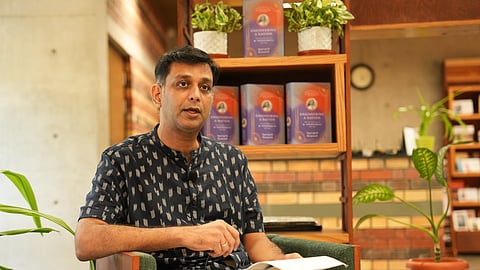
In the state, he is an icon and the subject of countless biographies. But Aparajith Ramnath, science historian, wanted answers to questions beyond the man’s impressive resume. His book Engineering a Nation: The Life and Career of M. Visvesvaraya (Penguin Viking; `1,299) which won the Kamaladevi Chattopadhyay NIF Book Prize 2025, attempts to reveal the person behind the legend. Excerpts:
What did you try to do with this book that others have not?
I wanted to use his life as a window into an interesting period in history from 1857 to 1947. His life (1861 to 1962) covers it almost entirely – he did not just live through it, he influenced it in important ways. I wanted to situate him in that context, not just list his achievements, understanding both his strengths and limitations.
How did you go about this research when he destroyed many diaries and letters?
He had some diaries he got rid of, but letters survive in different places. However, they’re not terribly personal but about his projects. That doesn’t mean that he only has formal relationships with people, but it’s certainly not like some others from whom you get intimate details of their doubts and fears. He also maintained an extensive scrapbook of newspaper cuttings, official reports and other ephemera. Looking at these and others’ accounts of working with him, help paint a picture – he had very particular ideas of things should be done. He was very reticent, he wrote a memoir but was very careful.
We don’t hear about his time in Pune before returning to KA. How did it shape him?
He spent 25 years in Bombay. He was in Nashik, visited Sindh, Gujarat and various places in the Deccan, too. His philosophy of development comes from those formative years in colonial bureaucracy, where he’s looking at how the colonial canal system is dealing with famine, making agriculture more productive, etc. Crucially, he is making his most important intellectual friendships in Pune, hanging out with MG Ranade, Gopal Krishna Gokhale and others. When he moves back, he’s in his late 40s. The end for many, became the start of his story.
You write about the myths surrounding Visvesvaraya, what is one widely believed story that is not true?
It is easy to prove when something is true but not always possible to prove that something is not. A story going around is that when he was travelling by train at night, he suddenly pulls the chain. When asked why, he says, ‘I could hear from the sound of the train that there’s a crack in the tracks ahead.’ Unless I account for every single journey in his life, [I cannot disprove it]. But there would have been some evidence, if it happened, which I haven’t found. However, it is true that he was very particular about his personal items.
Did you learn something you didn’t expect to?
He’s known primarily as an engineer but apart from his friendships the 9th century liberals, in the ’20s and ’30s, he actively worked with Congress moderates, pushing for Dominion status and producing a draft constitution for India with Dominion status. When princely states’ subjects are talking about democratic rights, he’s lending weight to that too. We see him as a serious figure but he had his moments of humour and was aware of his own eccentricities. There are also nuggets like his love for dogs and sports too.
In Karnataka, he’s an iconic figure, but not as much in other states. Who were you writing for?
I was writing for people around the country. For people not from Karnataka, I hope it is a portrait of his huge contributions in other parts of the country. For people in Karnataka, when someone becomes as ubiquitous as he is, we project our own hopes, fears and beliefs onto them. But we need to understand that there were limitations to his vision – a strongly science and technology focussed way of solving social and governance problems. Today, there are questions of sustainability – what does it mean for the environment to rely on large dams?
