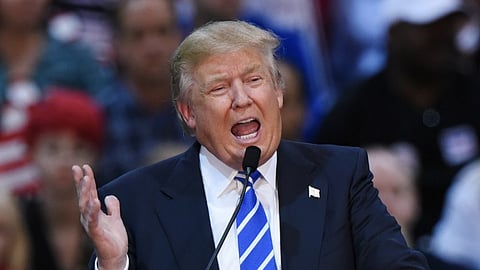

The White House has just announced a new global trade regime, effective 7 August. It impacts every nation. What we are seeing unfold is not just a change in policy; it is a new global order being written by the United States. Once the lead advocate of globalization, the Trump regime is now pivoting away from free trade to a new era of protectionism.
These Make-America-Great-Again (MAGA) changes will no doubt bring short term gains for some US business interests; but, long-term, they spell the erosion of US hegemony.
What has been announced is the universal tariff of 10% will remain for countries with which the US has a trade surplus. For 40 nations with who the US has a trade deficit – countries like India to which the US exports less than it imports – face a base rate of 15%. Where there are no deals, rates vary from 39% for Switzerland and 35% for Canada, to a readjusted 20% for Bangladesh and 19% for Indonesia.
At home in India, we were lulled into believing an interim deal was around the corner. Those who understood Donald Trump’s brinkmanship and his disdain for both friend and foe, saw it coming. For Trump there are no half measures. After mocking India as a ‘dead economy’, the US President announced 25% tariff. In addition, he threatened a barrage of unspecified penalties if India continued to buy oil and arms from Russia.
The Budget Lab at Yale University estimates that by 28 July, 2025, the average effective tariff rate imposed on imports into the US stood at 18.2 % -- the highest since 1934. It was just 2.4% in 2024, before Trump assumed office. In the short-term, the US has had a windfall. President Trump claims the US has creamed $150 billion in taxes since the new tariffs kicked in in April.
Slowdown coming
The immediate object of Donald Trump’s new tariff regime is to stoke domestic manufacturing by making foreign-produced goods more expensive; and to bring down the massive federal deficit budget which is currently touching $1.9 trillion. It is next to impossible to turn the clock back, but that Is a different discussion.
In the near term, there will be turmoil and pain. In the case of India, while government spokespersons are putting on a brave face, a slowdown is imminent. Exports will face more competition. Textiles and apparels, for instance, which compete with Bangladesh products, will be knocked out as the tariffs are lower for Dhaka. An array of sectors from jewelry to electronics are almost entirely dependent on US exports. These will go into deep freeze. Market watchers from ratings agency ICRA to brokerage house Nomura are forecasting GDP growth slowing between 30-40 basis points. This will be hard on an economy struggling to emerge from the dark recesses of the Covid pandemic.
For other export-led economies in Africa and south-east Asia that are facing tariffs in the 25-35% range, the barriers to the US market will be devastating too.
Meanwhile, it will be US businesses and consumers who will be paying for the higher tariffs. Manufacturing units will face higher input costs as Trump doubles down on steel and aluminum imports. An array of imported finished products too such as electronics, automobiles, toys and processed foods will potentially become more expensive. US households could see an average increase of $2,400 annually due to the tariffs, analysts say.
The cascading effect of reignited inflation, and weakening consumer demand might ultimately lead to a slowdown in the U.S., and even recession, stagnation in wages and job losses. Not exactly Trump’s MAGA vision he claims to be fighting for.
End of US hegemony?
Long-term, the chaos sown by the biting tariffs may actually contribute to building regional blocs that could challenge US’ hegemony. There are historical parallels. The Smoot-Hawley Tariff Act of 1930, which massively hiked U.S. tariffs on over 20,000 imported goods, created a slew of retaliatory measures from trading partners that worsened the Great Depression.
It is therefore no surprise that Trump is allergic to blocs such as BRICS as they strive to develop regional trade and an alternative currency to keep the dollar’s domination at bay.
As the US-dominated global trade fragments and becomes even more inequitable for the poorer nations, the building of regional markets and supply chains will intensify. As it is, Europe, Canada Japan and South Korea, who thought themselves as natural allies of the US, are now seeking local collaboration. Friedrich Merz, the new German chancellor, has called on the NATO allies for heavy investments in defense, calling the Trump regime ‘unreliable’. Germany has also promoted a 500-billion-Euro fund to develop Europe as an independent energy and infrastructure hub.
China-Russia trade is close to $300 billion currently, while ASEAN countries, on one hand, and the China-led Belt and Road Initiative (BRI) are developing independent partnerships in Africa and Asia to reduce dependence on the US markets and financial systems.
India, too, would do well to stand its ground and not bow to US pressure to end its multilateral trade and military options. Over the years, India’s regional leadership role has considerably diminished with friction with many of its neighbours including Bangladesh, Sri Lanka and Nepal. These relations have to be repaired, near-defunct bodies such as SAARC revived, and regional trade promoted.
